A full load of junk sells for $550 to $800, costs about $80 to $150 to dispose of, and takes a two-person crew roughly 90 minutes including the drive to the transfer station. Do four of those a day and the arithmetic on how to start a junk-removal business gets very interesting very fast. The catch is that the phone only rings if you show up first on Google and can quote a price in thirty seconds, and half the people who try this trade underprice heavy loads until dump fees eat their profit.
This guide is for someone ready to haul: a person with a pickup who wants to turn weekends into a real company, or someone planning to buy a truck and run junk removal full time. It covers the trailer-versus-truck decision, the permits that actually apply (including the USDOT rule that surprises people), insurance, how volume pricing works and how to quote it, where the first 20 jobs come from, and what changes when you add a second truck.
What a junk-removal business actually looks like day to day
A typical day is three to five stops: a couch and a mattress from a third-floor apartment, half a garage from a family moving out, a hot tub cut into pieces, a contractor’s pile of demolition debris. You quote on site, load, sweep, take a photo, collect payment, and drive to the transfer station once or twice. Evenings are answering quote requests, sorting scrap metal for the recycler, and dropping usable furniture at a donation center.
Demand is steady with spring and summer peaks: moving season, estate cleanouts, spring cleaning, and end-of-month tenant turnover. Realtors and property managers generate the most repeat work; homeowners generate the highest volume of one-time jobs. Average tickets land between $300 and $400, and dump fees run 10 to 20 percent of revenue depending on your local tipping fee and how much you divert.
The people who thrive like physical work, are comfortable walking into a stranger’s messy garage and naming a price without flinching, and can keep a truck running. It is one of the few businesses that pays from the first week. What kills junk-removal companies: pricing by the item instead of by volume and weight, a truck that spends two weeks a month in the shop, skipping commercial auto insurance, and relying on one lead source when its cost doubles.
Step 1: Choose your model and your first vehicle
The core decision is trailer or truck, and it shapes everything else.
- Pickup plus dump trailer. A 6x12 or 7x14 dump trailer ($6,000 to $10,000 new, $4,000 to $7,000 used) behind a three-quarter-ton pickup. Hydraulic dump means unloading in five minutes, and the trailer holds its value. Downside: harder to park in cities, and your daily driver is now a work truck.
- Pickup plus tall-sided utility trailer. $2,500 to $4,500. Cheapest start, but you unload by hand at the dump, which adds 30 to 45 minutes a trip and wears you out by 2 p.m.
- Used dump truck. A 14- to 16-foot cab-over dump body (Isuzu NPR, Hino, or a Ford F-450/550 with a dump bed) runs $25,000 to $45,000 used. Holds 12 to 18 cubic yards and looks like a real company with a wrap. Downside: financing, higher insurance, and if it breaks you have no revenue.
- Cargo van. Fine for single items and small loads, useless for a garage cleanout. A cargo van business is a different model.
Most operators start with a pickup and dump trailer, run 60 to 90 days, then buy the truck from revenue when the phone rings daily. Whatever you choose should carry 3,000 to 5,000 pounds of payload; a half-ton pickup loaded with concrete is already illegal.
Then decide what you will not take. Refrigerators, freezers and air conditioners need refrigerant recovered by a certified technician before disposal, so most operators pay a recycler $15 to $40 per unit. Tires, paint, chemicals and anything hazardous get a no every time; the fines are not worth a $200 job.
Step 2: Set up the legal side and the hauling permits
Form an LLC ($50 to $500 depending on your state; search “[your state] Secretary of State LLC filing”) and get a free EIN. You are moving heavy objects through people’s homes and driving a loaded trailer on public roads; the liability wall matters. Open a business bank account and a card reader the same week, because customers pay on site.
Then the permits specific to hauling:
- Local business license. $25 to $150 a year from your city or county.
- Waste hauler or solid waste collection permit. Many counties and cities require a license to transport solid waste for compensation, sometimes with an annual fee ($50 to $500), a vehicle inspection, and proof of insurance. Search “[your county] solid waste hauler permit” and call the solid waste department; this is the requirement that operators most often discover after a competitor reports them.
- USDOT number. Federally required if you cross state lines with a vehicle or combination rated over 10,001 pounds. A three-quarter-ton pickup and a dump trailer exceed that easily, and many states also require it for in-state commercial hauling. Registration is free on the FMCSA website; check your state DOT for the intrastate rule.
- Transfer station and landfill accounts. Open commercial accounts at the two nearest facilities and learn their tipping fee (typically $50 to $120 per ton), what they refuse, and their hours.
- Sales tax. Junk removal is a service and untaxed in most states, but a few tax it. Search “[your state] sales tax waste removal services.”
Watch out: Tipping fees are charged by weight, not volume. A half load of wet drywall or concrete can cost more to dump than a full load of furniture. Price heavy materials separately or the landfill scale will quietly take your margin.
Step 3: Get insurance that covers a loaded trailer
- Commercial auto: $2,000 to $5,000 a year for a pickup and trailer, $3,500 to $7,000 for a medium-duty dump truck. Your personal auto policy excludes commercial hauling; a claim with a trailer of junk behind you will be denied. Make sure the trailer is scheduled on the policy.
- General liability: $600 to $1,500 a year for $1 million per occurrence. Covers the scratched hardwood floor, the dented door frame, the neighbor’s car your trailer gate hit.
- Inland marine (equipment): $200 to $400 a year for dollies, tools and the trailer’s contents.
- Workers’ compensation: required in most states once you hire, and hauling is a high-rate class code, often $8 to $15 per $100 of payroll. Budget it before your first helper starts.
- Hired and non-owned auto: $150 to $400 a year if a helper ever drives their own vehicle for the business.
Progressive Commercial, Next, biBERK and local agents who write contractors all handle junk removal. Property managers and realtors will ask for a certificate of insurance; have it ready before the first pitch.
Step 4: Equipment and startup costs
Beyond the vehicle, the equipment list is short and cheap. Lean assumes you own a capable pickup already.
| Item | Lean setup | Full setup |
|---|---|---|
| Hauling vehicle | $4,000–$9,000 (used or new dump trailer behind your pickup) | $25,000–$45,000 (used 14–16 ft dump truck) plus $6,000 dump trailer |
| Hand trucks, appliance dolly, furniture dolly, moving straps | $400–$700 | $800–$1,500 |
| Tarps, ratchet straps, cargo net, contractor bags | $150–$300 | $300–$500 |
| Tools (sledgehammer, pry bar, reciprocating saw, bolt cutters, shovels, rakes, magnet sweeper) | $300–$600 | $800–$1,200 |
| PPE (gloves, steel-toe boots, safety glasses, respirators, back support) | $150–$300 | $400–$800 (two crews) |
| Insurance (first year) | $2,800–$6,000 | $5,500–$10,000 |
| LLC, hauler permit, USDOT, bank account | $200–$1,000 | $500–$1,500 |
| Website, Google Business Profile, truck lettering or wrap, yard signs | $400–$1,200 | $3,000–$5,000 (full wrap) |
| Card reader and scheduling software (first year) | $200–$500 | $800–$1,500 |
| Total | $8,600–$19,600 | $43,100–$73,000 |
Do not skip the lettering. A lettered truck in a driveway is seen by every neighbor, and “I saw your truck” is one of the top three answers when you ask customers how they found you. Buy dollies and straps new and good; a $40 appliance dolly that fails on a stairwell costs a fridge and a back.
Step 5: Price by volume, quote in thirty seconds
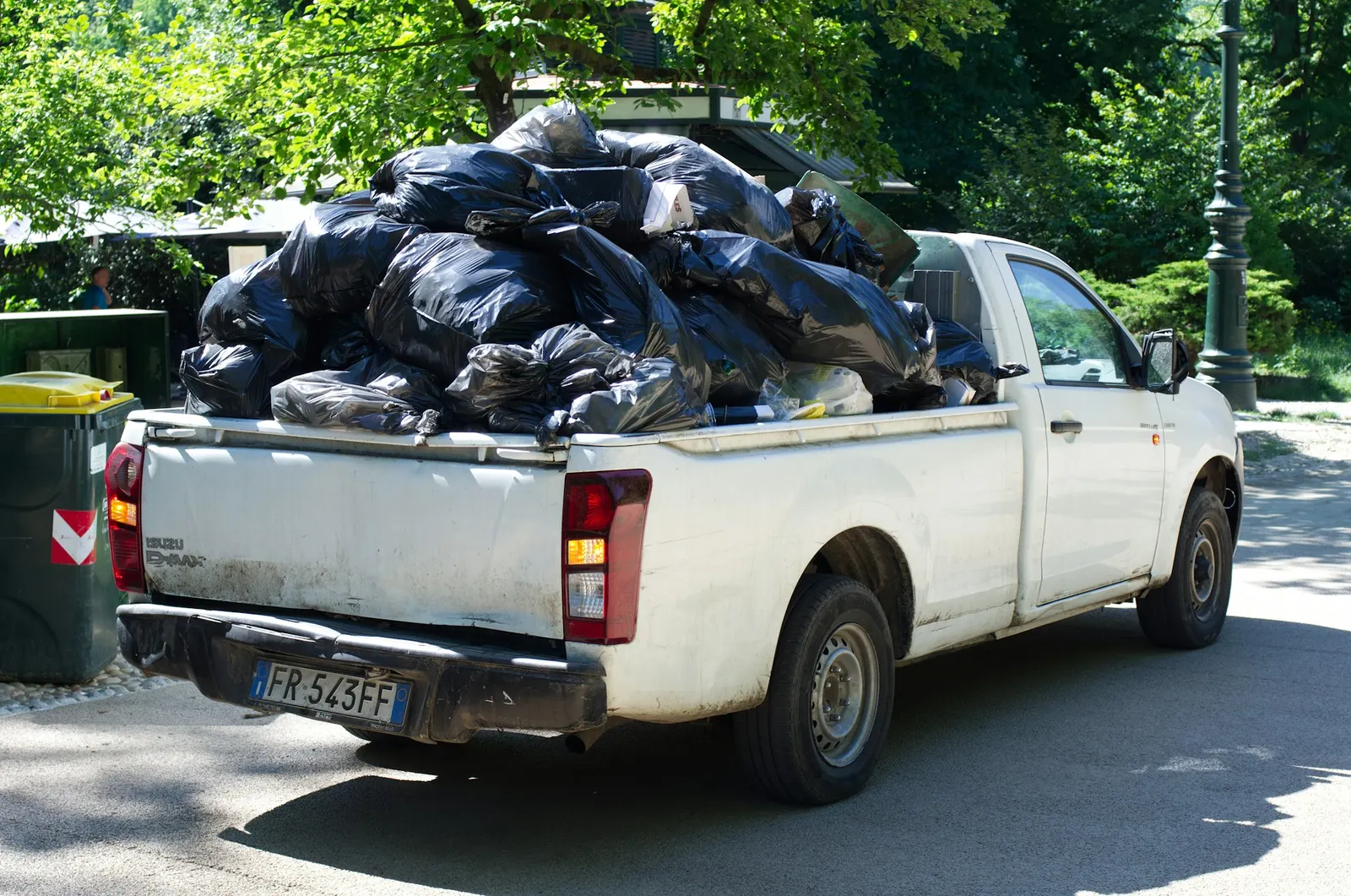
Junk removal is priced as a fraction of the truck, with surcharges for weight, stairs and special items. Customers have been trained to expect this by the national franchises, and it lets you quote on the spot with confidence.
| Load size (based on a 12–15 cubic yard truck) | Typical price (2026) | Examples |
|---|---|---|
| Minimum or single item | $100–$175 | One couch, one mattress, one dresser |
| Quarter load (3–4 cubic yards) | $200–$300 | A bedroom set, a small pile of yard waste |
| Half load (6–7 cubic yards) | $350–$475 | Half a garage, a full apartment’s furniture |
| Three-quarter load | $475–$600 | Most of a garage, a small estate cleanout |
| Full load (12–15 cubic yards) | $550–$800 | Full garage, basement cleanout, shed contents |
| Heavy materials (concrete, dirt, brick, shingles) | $250–$400 per half bed load | Priced by weight; landfill charges by the ton |
| Special items | $75–$600 each | Mattress $80–$150, refrigerator $100–$175, hot tub $300–$600, piano $300–$500 |
| Labor-only demo or disassembly | $75–$125 per hour per person | Sheds, hot tubs, above-ground pools |
Expensive coastal metros run 30 to 50 percent above these ranges; small towns 15 to 25 percent below. The national franchises publish their bands; 10 to 15 percent under them with faster response is a winning position for an independent.
Quote with a photo when you can. A quote form with photo upload lets you send a firm range in minutes, and customers who get a price in under an hour book at a much higher rate. On site, walk the pile, estimate cubic yards out loud, name the price, and stop talking. The math for a two-person crew doing four jobs a day at a $375 average: $1,500 a day, $7,500 a week, about $32,000 a month. Subtract dump fees ($3,500 to $5,500), fuel ($1,200 to $1,800), a helper ($3,500 to $4,500 for the month), insurance and software ($600 to $900), and truck reserve ($1,000), and the owner nets roughly $18,000 to $21,000 a month before tax. Solo with a trailer, expect half the jobs and a third of the profit.
Tip: Scrap metal is cash. Appliances, bed frames, grills and exercise equipment go to the recycler, not the landfill. A busy truck earns $200 to $600 a month in scrap and pays nothing to dump it.
Step 6: Get online and be the first result
Junk removal is bought in a hurry. Someone is moving Saturday, or the tenant left a mess, or the estate closes Friday. They search “junk removal near me,” look at the first three results with good reviews, and call the one whose site gives them a price range and a same-day option. Your website needs your service list, your service area with the towns named, a pricing page with the load-size table, before-and-after photos of real jobs, your reviews, a phone number that gets answered, and a get-a-quote form with photo upload. State what you do not take so people stop calling about paint.
You can have Restart build it: describe the business, what you haul, your area, your load-size pricing and how you want people to reach you, and it builds the pages, writes the copy, designs the site and publishes it to a real URL. Change anything afterwards by asking: add a hot tub removal page when you start doing them, update prices when the landfill raises its rate, swap in this week’s best before-and-after photos. Restart’s notes on local businesses cover what a service-area company should put on each page.
How to start a junk-removal business that ranks in the map pack
Create a Google Business Profile as a service-area business with “Junk removal service” as the primary category, list every town you cover, and post photos from every job. Then collect reviews at the truck: after the customer pays, hand them your phone with the review link open. Twenty reviews with photos beats a ten-year-old company with four. Once the profile is verified, apply for Google Local Services Ads, which places you at the very top with a “Google Guaranteed” badge and charges per lead ($25 to $60 in most markets); it is the single most effective paid channel in this trade. Add Nextdoor and the local Facebook groups where “anyone haul junk?” gets posted daily.
Step 7: Land your first 20 paying jobs
Homeowner searches fill the truck; relationships fill the calendar.
- Realtors. Every listing has a garage to empty and every closing has a move-out. Visit ten brokerage offices with a price sheet, offer 48-hour turnaround, and ask to be their cleanout vendor. One active agent is 10 to 20 jobs a year.
- Property managers. Evictions, abandoned units and tenant turnover, monthly, on net-15 terms. One manager with 100 doors is a route. Bring your certificate of insurance to the first meeting.
- Estate sale companies and senior move managers. They finish a sale on Sunday and need everything left gone by Tuesday. Recurring, and they refer aggressively.
- Contractors and remodelers. Demolition debris too small for a dumpster. Pair with a dumpster rental operator for bigger jobs and trade referrals.
- Storage facilities. Abandoned units get auctioned and the leftovers need hauling.
- Yard signs and the truck. Leave a sign for a week after each visible job.
- Thumbtack and Angi. Leads at $15 to $50 each. Useful for the first month; move budget to Local Services Ads once verified.
What to say: “We haul anything but hazardous waste, same day or next day, priced by how much of the truck you fill; a half load is $350 to $475.” What to charge for the first five jobs: your real price. Discounting teaches referral partners that your rate is negotiable, and they will negotiate forever.

Step 8: Run the route and scale to a second truck
Habits that keep the truck profitable:
- Two-hour arrival windows and a text when you are 20 minutes out. Customers are stressed and moving; reliability is the review.
- Payment on site, every time. Card reader at the truck; net-15 invoices only for commercial accounts.
- Dump strategy. Batch small jobs into one transfer station trip, hit the scrap yard on the way, drop donations weekly. Every trip you avoid is 45 minutes and a fee.
- Photos of everything, including pre-existing damage to floors and walls, sent to the customer.
- Scheduling software. Jobber, Workiz or Housecall Pro for booking, quotes, invoicing and review requests.
Scaling is one truck at a time. A single two-person truck tops out around four to six jobs a day and $350,000 to $450,000 a year in revenue in a strong market. The second truck roughly doubles revenue but needs a second crew of two, a dispatcher (usually you), a second commercial auto policy, and a marketing budget large enough to fill two schedules; expect 60 to 90 days of the second truck losing money. What breaks at 2×: crew no-shows on a booked Saturday, inconsistent quoting between crews, and truck downtime with no backup. Fix quoting with a laminated price card and training before the second truck arrives, and keep the trailer as a backup unit.
How much can you make?
Scenarios below use a $375 average ticket, dump fees at 15 percent of revenue, and costs covering fuel, insurance, software, marketing, labor and vehicle reserve.
| Level | Volume | Annual revenue | Annual costs | Annual profit |
|---|---|---|---|---|
| Side income (weekends, pickup and trailer, solo) | 6 jobs a week at $325 | $100,000 | $42,000 | $58,000 |
| Full-time one truck (you plus one helper) | 18 jobs a week at $375 | $350,000 | $205,000 | $145,000 |
| Two trucks (you dispatching and selling, two crews) | 40 jobs a week at $375 | $780,000 | $560,000 | $220,000 |
The side-income row assumes full weekends booked from Google and referrals, which takes a few months to build. The one-truck ceiling is jobs per day, set by daylight and the distance to the dump. Beyond one truck, profit per truck falls as you add labor, management and marketing. Many operators find one well-run truck plus a trailer for overflow is the most profitable shape per hour worked.
Mistakes that sink new junk-removal business owners
- Pricing heavy loads by volume. A half trailer of concrete weighs two tons and the landfill charges by the ton. Fix: heavy materials priced separately, always.
- Running on personal auto insurance. One accident with a loaded trailer and the claim is denied. Fix: commercial auto with the trailer scheduled, before the first paid job.
- Ignoring the hauler permit. A competitor reports you, and the county fines you. Fix: call the solid waste department in week one.
- Taking hazardous waste to be nice. Paint, chemicals, asbestos tile. Fix: a published do-not-take list and a referral to the county hazardous waste drop-off.
- One lead source. Thumbtack doubles its lead price and your calendar empties. Fix: Google Business Profile with reviews, Local Services Ads, and three referral relationships within 90 days.
- Slow quotes. The customer who waited six hours for a price already booked someone else. Fix: photo quote form, reply within an hour, price on the spot in person.
Your first 30 days
Week 1
- Decide trailer or truck; line up the vehicle and confirm its payload and combined weight rating.
- File the LLC, get your EIN, open a business bank account and a card reader.
- Call the county solid waste department about a hauler permit; apply for a USDOT number if your combination is over 10,001 pounds.
- Build the website on Restart with services, load-size pricing, service area, and a photo quote form; create your Google Business Profile.
Week 2
- Bind commercial auto (trailer scheduled) and general liability; get your certificate of insurance.
- Buy dollies, straps, tarps, tools and PPE; letter the truck or trailer.
- Open accounts at the two nearest transfer stations and find your scrap yard and donation drop-off.
- Set up scheduling and invoicing software with a review request that sends after each job.
Week 3
- Haul three jobs for friends, family or a local Facebook post at full price; take before-and-after photos and get three Google reviews.
- Visit ten realtor offices and three property managers with a price sheet and your certificate of insurance.
- Post before-and-after photos with pricing in two local Facebook groups and on Nextdoor.
- Apply for Google Local Services Ads once the profile is verified.
Week 4
- Book your first 10 to 15 paying jobs; batch them by neighborhood and dump run.
- Hand every customer the review link at the truck before you leave.
- Track dump fees, fuel and time per job to confirm your price bands hold.
- Set aside 5 to 8 percent of revenue for the vehicle reserve from the first deposit.