A roll-off dumpster earns its owner money only while it is sitting in someone’s driveway, and a $6,000 container that turns four times a month at $450 pays for itself in about four months. The truck, the permits and the marketing exist to keep as many cans as possible in driveways. Most people researching how to start a dumpster rental business fixate on the truck; the operators who make money fixate on utilization and tonnage.
This business is also more capital-intensive than its cousin, junk removal, and it rewards people who understand that a landfill’s per-ton fee is the second most important number in the company after the rental price. Get those two numbers right and a single truck with a dozen containers can net a solo operator $90,000 to $140,000 a year.
This guide is for someone with $40,000 to $250,000 to invest (mostly financed), a tolerance for early mornings and diesel, and a metro with enough remodeling to keep cans moving. It covers the truck decision, permits and USDOT rules, insurance, container economics, the 7-day pricing model, getting contractors to call you, and what breaks at two trucks.
What running a dumpster rental company actually looks like
A day for an owner-driver: leave the yard at 6:30 a.m. with an empty 20 yard on the truck, deliver it to a roofing job by 7:15, pick up a full 15 yard from a kitchen remodel, drive it to the transfer station, wait in line, tip it, weigh out, drop the empty at the next customer, repeat. A good day is six to ten “moves” (deliveries, swaps or pickups). Between moves you answer the phone, quote sizes, and explain that a mattress costs extra.
Demand follows construction, remodeling and weather. Spring through fall is busy; December through February drops 30 to 50 percent in cold climates. Storm cleanup, roofing season after hail, and the spring cleanout wave in April and May are the peaks. Contractors generate steady repeat volume; homeowners generate higher margins and more phone calls.
The people who thrive here like equipment, route well, and can build relationships with roofers, remodelers and property managers. What kills these businesses is under-capitalization (truck payment plus dump fees due before customers pay), under-billing tonnage (a 20 yard of shingles weighs four to five tons and costs $300 to tip), and too few containers for the truck.
Two signals: a 20 yard rents for $425 to $650 a week in most US metros, and tipping fees run $40 to $110 a ton by region. The gap between those numbers, minus fuel and time, is the business.
Step 1: Choose your equipment model
Your truck determines your container sizes, your customer mix and whether you need a CDL. There are three ways in.
Hook-lift truck (non-CDL)
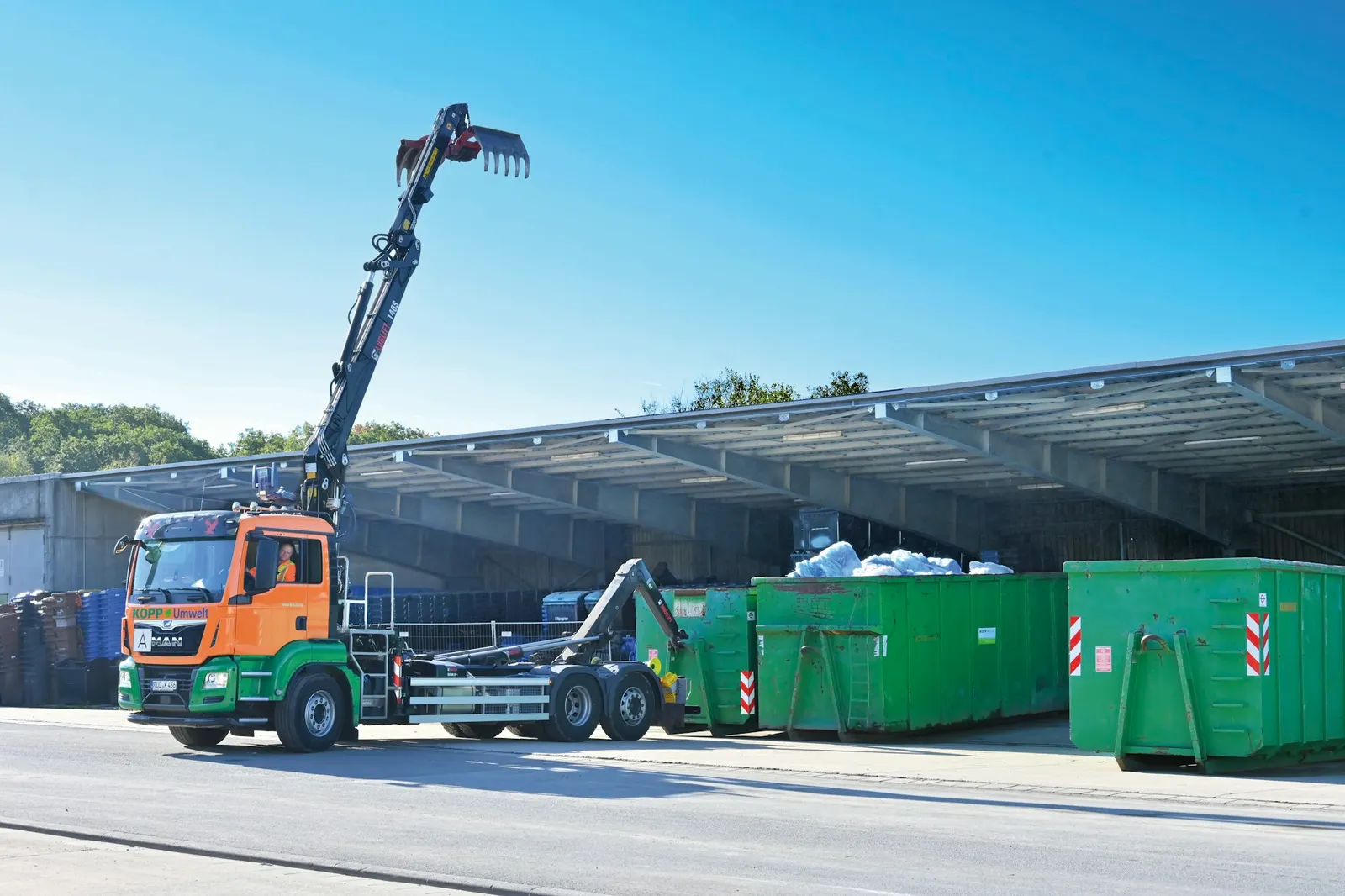
A hook-lift on a 26,000-pound GVWR chassis (Ford F-650/F-750, Ram 5500, Isuzu NRR, Freightliner M2) handles 10 to 20 yard containers without a CDL. Used trucks run $55,000 to $120,000; new setups $150,000 to $200,000. This is the most common starting point for residential and light-construction work because you can hire non-CDL drivers, a real advantage in a tight labor market.
Traditional roll-off truck (CDL)
A cable-hoist roll-off on a 33,000 to 60,000-pound chassis hauls 10 through 40 yard cans and is the standard for construction and commercial work. Used, $75,000 to $150,000; new, $180,000 to $260,000. You and every driver need a Class B CDL. Higher revenue per move on 30s and 40s, bigger truck payment, higher insurance.
Dump trailer or trailer dumpsters
A one-ton pickup pulling a roll-off trailer with 10 to 15 yard driveway-safe bins. $35,000 to $70,000 including three or four bins. Lowest cost, lowest capacity, popular in suburbs where homeowners care about their driveway. You will not win construction work with this rig.
Tip: Start with 10, 15 and 20 yard containers only. They fit residential driveways, stay under weight limits on the non-CDL truck, and cover 80 percent of residential and remodeling demand. Add 30s when contractors ask and you have a CDL truck.
Step 2: Set up the company and get the permits
Entity, EIN, tax registration
Form an LLC. You are putting heavy steel on people’s property and driving a 13-ton truck; the liability shield matters. Get an EIN, open a business bank account, and register for a sales tax permit. Whether dumpster rentals are taxable varies (some states tax the rental, some treat hauling as a nontaxable service), so ask when you register.
USDOT and motor carrier registration
Any commercial vehicle over 10,001 pounds GVWR in interstate commerce needs a USDOT number, and most states require a USDOT number or intrastate motor carrier registration for trucks that never leave the state. Search “[state] intrastate USDOT requirements.” Your truck also needs an annual DOT inspection and a driver qualification file for every driver; CDL drivers must be enrolled in the FMCSA Drug and Alcohol Clearinghouse. The USDOT number is free; get it the first week.
Waste hauler and container permits
This is where it varies most. Many counties require a solid waste hauler license ($100 to $1,500 a year) for anyone transporting debris for a fee, and some cities require a hauler agreement or register each container. Call the county solid waste department and ask, “What does a roll-off container company need to legally haul debris in this county?” Then call the city public works office about right-of-way permits for cans on a public street, because customers will ask you constantly.
Landfill and transfer station accounts
Open a commercial account at the two nearest landfills or transfer stations for a per-ton rate, a scale card, and monthly billing instead of paying at the gate. Get the surcharge list (mattresses, tires, refrigerant appliances, mixed loads) and the prohibited materials list; it becomes your website’s “what you can’t put in the dumpster” page.
Step 3: Insure the truck, the cans and the customer’s driveway
Insurance for a hauling business is expensive, and the quotes vary widely between carriers, so get three.
- Commercial auto liability ($1M): the truck, in motion and while loading. $8,000 to $18,000 a year for one truck, higher in states with steep verdicts and for a new business with no loss history.
- General liability ($1M/$2M): a container that cracks a driveway, a customer who trips over a rail. $1,500 to $3,500 a year. Ask specifically whether driveway damage is covered; some policies exclude property in your care.
- Inland marine: the containers themselves, on site or in transit. Cans get stolen and hit by cars more than you would think. $600 to $1,500 for $60,000 of containers.
- Pollution liability: a contaminated load or a hydraulic leak on a driveway. Increasingly required by commercial and municipal customers. $800 to $2,500.
- Workers’ compensation: as soon as you hire a driver. $3,000 to $7,000 a year for one or two.
Budget $12,000 to $25,000 for year-one insurance with one truck, and have the agent set up a certificate process; general contractors require a COI naming them as additional insured before your can rolls onto their site.
Step 4: Buy the truck and containers, and budget honestly
How to start a dumpster rental business with four cans
Container math first: a new 20 yard can costs $5,500 to $8,000 in 2026; a 10 yard, $4,500 to $6,500; used cans in decent shape, $3,000 to $5,000. Hook-lift and cable-style containers are not interchangeable, so commit to a system before your first can. Buy from a fabricator within driving distance; freight on a steel box is $500 to $1,500.
| Item | Lean start (dump trailer, 4 bins) | Full setup (used hook-lift, 10 cans) |
|---|---|---|
| Truck or tow vehicle and hoist system | $28,000 | $85,000 |
| Containers | $14,000 | $60,000 |
| Tarps, straps, wheel chocks, driveway boards, shovel, broom | $600 | $1,500 |
| Truck lettering or wrap; container stenciling with name and phone | $800 | $3,500 |
| LLC, USDOT, hauler permits, DOT inspection | $700 | $2,500 |
| Insurance (first year) | $7,000 | $18,000 |
| Dispatch/booking software and phone system (first year) | $600 | $2,400 |
| Website, Google Business Profile photos, door hangers, contractor flyers | $500 | $1,500 |
| Working capital for dump fees, fuel and repairs (90 days) | $6,000 | $20,000 |
| Total | $58,200 | $194,400 |
A used hook-lift truck financed over five years at 9 to 12 percent runs $1,700 to $2,200 a month. Lenders will finance containers too, but buy cans with cash as you grow. Keep at least $15,000 in working capital: dump fees are due monthly and a hydraulic pump failure is a $3,000 repair.
Step 5: Price the way the market prices
Dumpster rental prices as a flat rental period that includes a tonnage allowance, with everything else billed as an add-on. Customers compare on the flat number, so keep it competitive and make sure your allowance and overage rate protect you.
| Container size | Typical uses | 7-day rental price | Included tonnage | Overage per ton |
|---|---|---|---|---|
| 10 yard | Bathroom remodel, garage cleanout, dirt or concrete (heavy) | $300–$450 | 1–2 tons | $65–$125 |
| 15 yard | Kitchen remodel, flooring, small roof | $375–$525 | 2 tons | $65–$125 |
| 20 yard | Whole-home cleanout, roofing up to 30 squares, decks | $425–$650 | 2–3 tons | $65–$125 |
| 30 yard | New construction, large demo, commercial cleanout | $525–$800 | 3–4 tons | $65–$125 |
Add-ons: extra days beyond the rental period ($10 to $25 a day), a swap (pickup full, drop empty) at 80 to 90 percent of a new rental, mattresses and box springs ($25 to $50 each), tires ($10 to $25), appliances with refrigerant ($35 to $75), and a trip fee ($100 to $175) if you arrive and cannot deliver or pick up because a car is blocking the spot or the can is overfilled. Heavy material (concrete, dirt, brick) goes in a 10 yard only, filled to a marked line, at a flat price with no tonnage allowance because you will be at the truck’s weight limit regardless.
The math that gets to a monthly income
Assume 10 containers averaging 3.5 turns a month each at an average rental of $475: 35 rentals and $16,625. Add tonnage overages and add-ons averaging $60 per rental: $2,100. Revenue: $18,725. Costs: dump fees at 2.2 tons average and $70 a ton ($5,390), fuel for 35 moves plus dump runs ($1,400), truck payment ($1,900), insurance ($1,500), maintenance and tires ($700), software, phone and marketing ($500). That is $11,390 in costs and roughly $7,300 for the owner-driver before tax. Push utilization to 4.5 turns and add three more cans, and the same truck nets $11,000 to $13,000.
Watch out: Weigh every load and bill every overage the same day. A 20 yard of roofing shingles or a cleanout with wet carpet can hit five tons, which is $200 to $300 in extra dump fees. Operators who “let it go” to avoid an awkward call are giving away their entire margin on that rental.
Step 6: Get online and be the company contractors can find at 6 a.m.
Dumpster customers search on their phone when they need a can in the next 24 to 72 hours: “dumpster rental near me,” “20 yard dumpster [city],” “dumpster rental cost.” A homeowner calls whoever shows a price, a size guide and a phone number that is answered.
A dumpster rental website needs: a size guide with a photo of each container next to a person for scale and a list of what fits, flat-rate prices per size with tonnage allowance and rental period stated, an accepted and prohibited materials page, your service area by town or ZIP, placement details (clearance, surface, driveway boards), a contractor page with account billing and swap pricing, real photos of your cans on real driveways, and a booking form that captures size, date, address and material type. Put the phone number in the header and answer it from 6 a.m. to 7 p.m.
You can have Restart build it: describe the company, your container sizes and prices, your area, what you accept and how you want people to book, and it builds the pages, writes the copy, designs the site and publishes it to a real URL. Change anything afterwards by asking, which you will do every time dump fees move and you adjust prices. Restart’s overview of local businesses shows what similar companies have set up.
Set up Google Business Profile as a service-area business under “Dumpster rental service,” post photos weekly, and ask every homeowner for a review at pickup. Fifteen reviews with photos of clean driveways will move you onto the map pack within a season. Then run a small Google Ads campaign on “dumpster rental [city]” with call extensions; expect $8 to $25 per click and $40 to $90 per booked rental, which pays on a $475 ticket.
Step 7: Land your first customers
Your first 20 rentals should build two things: a base of contractors who call every week, and enough reviews and photos to make homeowners trust you.
Channels that work for dumpster rental
- Roofers, remodelers, flooring installers and demo crews. Visit job sites with a flyer offering contractor pricing, net-15 billing after three paid rentals, and same-day swaps. A single busy roofer can rent 8 to 15 cans a month.
- Property managers and apartment complexes. Turnovers, evictions and renovations. Offer a standing account rate.
- Real estate agents and estate attorneys. Cleanouts before listing or after a death. They refer constantly if you are reliable.
- Junk removal and moving companies. They sell labor; you sell steel. A moving company sends you cleanouts they cannot haul, and you send them lifting jobs.
- Google Business Profile, Google Ads and Nextdoor for homeowners. Answer the phone on the first ring.
- Municipal and storm work. Register as a vendor with your city and county; storm debris contracts are lucrative and fast to bid.
What to say and what to charge
For the first five rentals, quote market rate and add value instead of discounting: three free extra days, or a free swap for contractors who commit to a second can. Say: “We’re a new local company with new cans and we’ll be there when we say we will.” Homeowners pay by card at booking, in full; contractors get net-15 only after three rentals paid on time. Confirm placement by text the evening before, send a photo of the delivered can, and state the pickup date in writing.
Use a one-page rental agreement covering rental period and daily overage, included tonnage and per-ton overage, prohibited materials, fill line, driveway damage waiver (you place boards; they accept the risk on soft asphalt), trip fee, and who obtains a street permit. Photograph the driveway before and after every placement.
Step 8: Run the routes, then add cans and a second truck
Operations that keep the truck moving
Route by geography, not by order of calls: cluster moves by side of town and hit the transfer station once or twice a day with full loads. Track every container (where it is, when it went out, when it is due back) on a whiteboard until you have eight to ten cans, then in roll-off dispatch software (Docket, Hauler Hero, ServiceCore and similar, $150 to $400 a month) that handles bookings, tonnage and invoicing. A can that stays two extra days unbilled is $30 to $50 gone.
Hiring a driver
Your first hire is a driver, which frees you to sell and dispatch. A non-CDL hook-lift driver earns $20 to $28 an hour; a CDL roll-off driver, $24 to $34. Every driver needs a clean MVR, a DOT medical card and a driver qualification file, plus Clearinghouse registration and drug testing for CDL trucks. Ride with them for a week. The skills that matter are backing a 13-ton truck into a tight driveway without hitting a gutter and enforcing a fill line without an argument.
What two trucks looks like
A second truck makes sense when the first is doing eight to ten moves a day and customers are waiting two days. Twenty to 25 cans, two trucks and two drivers grosses $40,000 to $55,000 a month. Your job becomes dispatch, sales and repair scheduling. What breaks first is cash: 25 containers means another $120,000 in steel and a second truck payment before the second truck has earned anything. What breaks second is the yard: two trucks and 25 cans need a half acre of commercially zoned gravel, $1,500 to $4,000 a month in most metros.
How much can you make?
| Level | Containers and turns per month | Monthly revenue | Dump fees, fuel, truck, insurance, labor | Owner net before tax |
|---|---|---|---|---|
| Side income (dump trailer, 4 bins, 10 rentals) | 4 cans, 2.5 turns | $4,300 | $2,700 | $1,600 |
| Full-time owner-driver (hook-lift, 12 cans) | 12 cans, 4 turns | $25,000 | $14,500 | $10,500 |
| Small fleet (2 trucks, 25 cans, 2 drivers) | 25 cans, 4 turns | $53,000 | $39,000 | $14,000 |
If you are working out how to start a dumpster rental business and keep it, the owner-driver row is the best return on effort: $10,000 to $13,000 a month in season, $6,000 to $8,000 in winter, with your labor inside the number. The two-truck row is what the owner keeps after paying two drivers and nothing for their own dispatching, which is why many operators sit at one truck and 15 cans for years. The path to a real ceiling is three or more trucks, a yard, an office manager and commercial contracts, at which point you are running a small waste company with a small waste company’s headaches.
Mistakes that sink new dumpster rental owners
- Too few cans for the truck. Four containers cannot cover a $2,000 truck payment plus insurance. Have a plan to reach ten within six months.
- Not billing overages. Weigh every load, bill the same day, and put the per-ton rate in bold on the agreement. This is the margin.
- Skipping the driveway photos. A homeowner will blame a two-year-old crack on your can. Before-and-after photos end the conversation.
- No working capital for dump fees. The landfill bill arrives before the contractor pays. Keep 90 days of dump fees in the account.
- Letting cans sit unbilled. Set an automatic reminder for the pickup date and charge extra days. Free days are how utilization dies.
- Taking a 40 yard job with a 26,000-pound truck. Overweight tickets are $500 to $2,000 and put your DOT safety score at risk. Know your legal payload and decline what you cannot haul.
- Buying the truck before checking hauler permits. Some counties limit hauler licenses or require franchise agreements. Make the calls first.
Your first 30 days
Here is how to start a dumpster rental business in a month, assuming the truck and cans can be sourced in that window.
Week 1
- Form the LLC, get the EIN, open a business bank account, register for sales tax.
- Call the county solid waste department and the city public works office; write down hauler license and street permit rules.
- Apply for the USDOT number and state intrastate registration.
- Open commercial accounts at the two nearest landfills or transfer stations and get the prohibited materials list.
- Build the website on Restart with a size guide, prices, accepted materials, service area and a booking form.
Week 2
- Get three insurance quotes for commercial auto, general liability, inland marine and pollution; buy and set up the COI process.
- Decide on hook-lift, roll-off or trailer; inspect two or three used trucks with a diesel mechanic.
- Order the first four to six containers from a fabricator within driving distance; request stenciling.
- Set prices, write the one-page rental agreement, and set up Google Business Profile.
Week 3
- Take delivery of the truck; complete the DOT inspection, lettering and driver qualification file.
- Stage the yard: gravel pad, driveway boards, tarps, straps, a spot for each can.
- Print contractor flyers with contractor pricing and swap rates; visit 15 job sites and three property management offices.
- Photograph each container size on a driveway for the website and Google.
Week 4
- Deliver your first cans at market rate with a free extra three days; text a photo of every placement.
- Weigh and bill every load; send invoices the same day.
- Ask every homeowner for a review at pickup; post the photos.
- Track utilization for the month and set a date to order the next three containers.