A photo booth earns $250 to $400 an hour of run time and costs about $25 an hour in prints and consumables. Almost nothing else in the events business has that margin. The catch is that the booth only earns while it is at an event, and a solo operator with one booth can physically be at about 100 events a year, nearly all of them between Friday evening and Sunday afternoon. Everyone learning how to start a photo booth or 360 photo booth business underestimates how much of it is sales, and overestimates how much of it is photography.
This guide covers how to start a photo booth or 360 photo booth business in 2026: which type of booth to buy first, what it costs, how to price packages, what venues require before they let you through the door, and the vendor-list strategy that fills a calendar without paying for ads. It is written for someone starting with one booth and their own weekends, whether the goal is $15,000 of side income or a two-booth company.
Expect to spend $3,500 to $7,000 for a self-assembled open-air booth or $10,000 to $18,000 for a turnkey booth plus a 360 platform, and 4 to 8 weeks from decision to first paid event, most of it waiting for the first bookings.
What a photo booth business actually looks like day to day
A typical Saturday: load the car by 2 p.m. (booth shell or camera stand, backdrop and frame, printer, lighting, prop bin, table and linens, cables, spare media), drive to the venue, load in through the service entrance, set up in 45 to 60 minutes, run the booth for 3 to 4 hours while keeping the line moving and the prints flowing, tear down in 30 minutes, drive home at midnight. Sunday you deliver the online gallery, answer inquiries and clean lipstick off the props.
The rhythm of the year matters more than the hours. Weddings run April through October with peaks in May, June, September and October; corporate holiday parties fill the first three weekends of December; proms and graduations land in April through June; quinceaneras, sweet sixteens and bar mitzvahs happen year round. January through March is slow for everyone, which is when you sell for the rest of the year.
The economics are simple. A 3-hour wedding package books for $700 to $1,200. Direct costs are prints (about $0.15 to $0.25 per 4x6, so $40 to $80 for a busy event), software ($40 to $100 a month), fuel and props. What kills these businesses is not cost; it is an empty calendar in year one, a printer that jams at 9 p.m. with no backup, and competitors who race to $400 packages until nobody makes money.
The people who thrive are hosts. You will spend four hours coaxing shy uncles into a prop mustache and fixing a backdrop a toddler pulled down, cheerfully, at 10 p.m. on a Saturday.
Step 1: Pick your booth type and your market
Choose the booth that fits the events you can actually book, not the one that looks best on Instagram.
| Booth type | What it is | Turnkey cost | Books for (3 hours) | Best market |
|---|---|---|---|---|
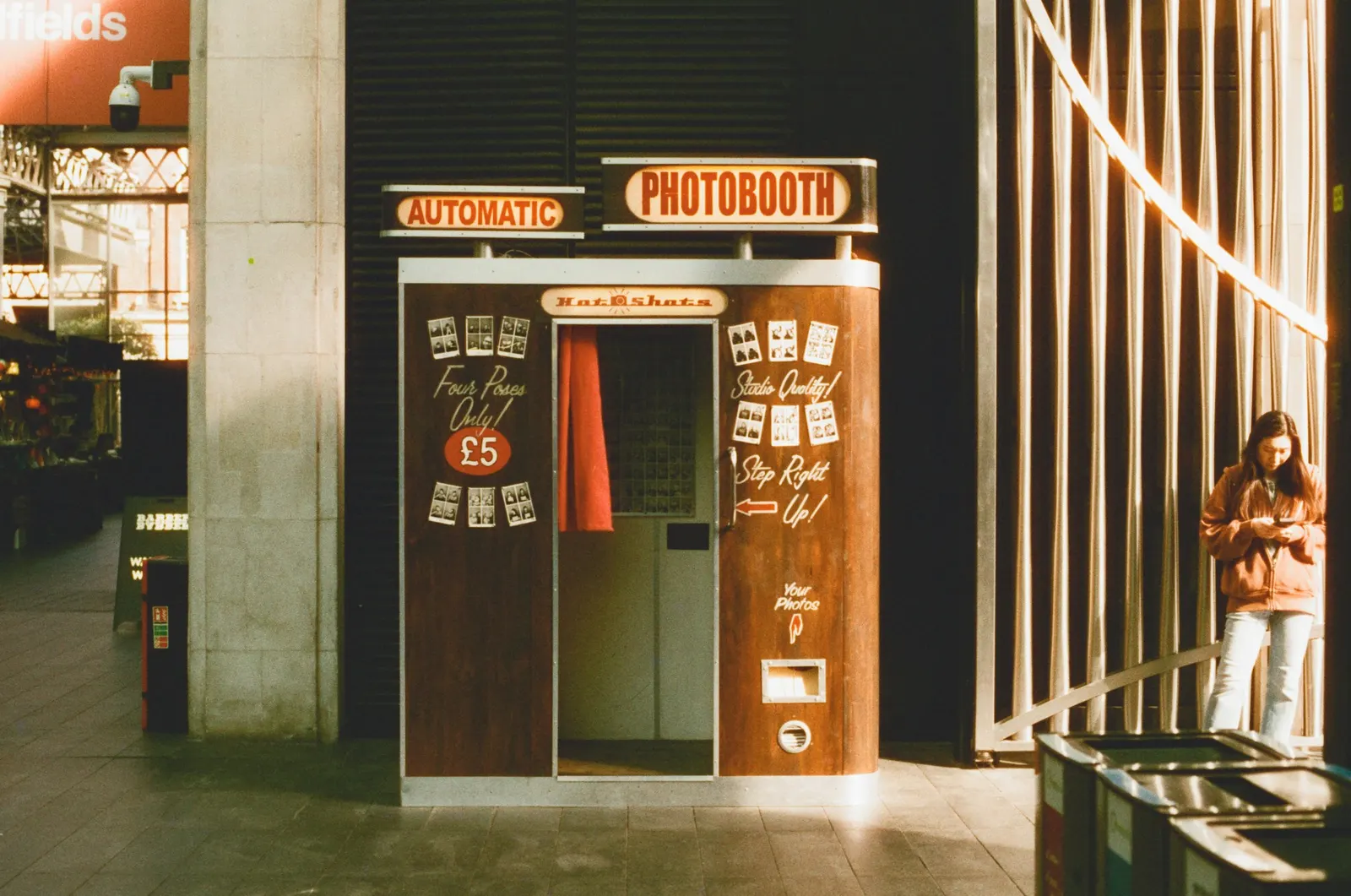
| Open-air print booth | DSLR or iPad on a stand, backdrop, dye-sub printer, attendant | $4,000–$10,000 | $600–$1,200 | Weddings, corporate, school events |
| iPad or “selfie” booth | iPad shell with ring light, digital sharing, optional printer | $1,500–$4,000 | $400–$800 | Budget weddings, parties, drop-off rentals |
| 360 video booth | Rotating camera arm around a platform, slow-motion video | $2,500–$6,000 | $800–$1,500 | Quinceaneras, sweet sixteens, corporate, nightlife |
| Enclosed or vintage booth | Cabinet with curtain, classic strips | $8,000–$20,000 | $900–$1,600 | Upscale weddings, venues, permanent placement |
| Mirror booth | Full-length interactive mirror | $6,000–$12,000 | $900–$1,500 | Weddings, galas |
Most successful new operators start with an open-air print booth because it books the widest range of events and prints are still what wedding guests take home. A 360 booth is the best second unit: same clients, higher price, and it films the party in a way a print booth cannot. A 360 booth as your only product means competing in the most crowded segment of the market with the least differentiation.
Then decide your market. Weddings are the biggest pool but book 6 to 12 months out and are price-compared on The Knot. Corporate events (holiday parties, conferences, brand activations) pay more, book faster, and want branded print templates and data capture. School events (proms, project graduation, after-prom) book through PTAs and student councils and pay $800 to $1,500 for a longer run with no alcohol.
Tip: A booth on its own is a commodity. A booth with a custom-designed print template, a backdrop that matches the couple’s colors and a guest book delivered at the end of the night is a $1,200 booking.
Step 2: Legal setup and what venues will ask you for
- Entity. Form an LLC ($50 to $500 depending on the state). You are bringing electrical equipment and a hundred pounds of gear into venues full of people; the LLC keeps a guest’s tripped-over-a-cable claim away from your personal assets. Get a free EIN and open a business checking account.
- Business license. A general city or county business license ($25 to $150 a year). Some cities require a home-occupation permit if you store equipment at home.
- Sales tax. Many states treat a photo booth as either an equipment rental or a taxable service, and prints as tangible goods. Register for a sales tax permit and search “[your state] sales tax photo booth rental” or call the department of revenue; getting this wrong shows up as a back-tax bill in year three.
- Contracts. A booking agreement covering date, hours, location, package, a non-refundable retainer (usually 25 to 50 percent), the balance due 14 days before, an idle-hours rate, what happens if the venue has no power or the event runs late, a weather clause for outdoor events, and a photo release for using images in marketing.
- Music licensing does not apply to you unless you play music at the booth; leave that to the DJ.
- Certificate of insurance. Nearly every venue asks for one, often naming the venue as additional insured, before load-in. Have it as a PDF you can send in a minute.
Step 3: Insurance for a photo booth business
| Coverage | Why | Typical annual cost |
|---|---|---|
| General liability, $1,000,000 per occurrence / $2,000,000 aggregate | Venue requirement; a guest trips on your cable or the backdrop frame falls | $450–$1,000 |
| Inland marine (equipment) | Camera, printer, iPad, 360 platform stolen from the car or dropped on a loading dock | $250–$600 for $10,000 of gear |
| Hired and non-owned auto | You or an attendant driving gear to events | $150–$400 |
| Workers’ compensation | Required once you hire attendants as employees | $800–$2,000 |
Event-specific policies exist (a single-event certificate costs $60 to $150), but if you plan to work more than five events a year an annual policy is cheaper and lets you send certificates on demand. Homeowner’s insurance does not cover business equipment; the inland marine policy is what replaces a $1,200 printer that walks off at a hotel ballroom.
Step 4: Equipment and startup costs
You can buy a turnkey booth from a manufacturer or assemble the same thing for about half the price. Either way, the printer is the heart of it.
| Item | Lean self-assembled | Full turnkey setup |
|---|---|---|
| Camera: Canon EOS Rebel or 90D with kit lens, or iPad Pro | $450 (used DSLR) | $1,200 |
| Booth shell or stand with iPad mount and ring light | $250 (stand and clamp) | $2,500–$4,500 (manufacturer shell) |
| Dye-sublimation printer: DNP DS-RX1HS or DS620A | $750 | $1,300 |
| Print media, 4x6, first 1,400 prints | $220 | $220 |
| Software subscription (Snappic, Darkroom, dslrBooth, Curator, Salsa) | $40–$60 a month | $80–$120 a month |
| Backdrop stand and 2–3 backdrops (sequin, white, green screen) | $180 | $600 |
| Continuous LED lighting or speedlight and softbox | $120 | $400 |
| Props, prop signs, table and linens | $150 | $450 |
| 360 booth: 100 cm platform, camera arm, ring light, iPhone | $0 | $3,000–$5,000 |
| Cases, dolly, cables, surge protector, extension cords | $150 | $500 |
| Insurance, first year | $600 | $1,600 |
| LLC, EIN, business license, sales tax permit | $150 | $500 |
| Website, domain, Google Business Profile | $50 | $300 |
| Print template design (Canva or a designer) | $0 | $300 |
| Total | $3,100–$3,300 | $13,000–$18,000 |
Buying notes from operators. The DNP DS-RX1HS prints a 4x6 in about 12 seconds and handles 700 prints per roll set; the DS620A is faster and takes larger media, and both are far more reliable than any inkjet. Keep spare media and cables in the car. Software matters more than the camera: it runs the countdown, applies the template, prints, texts the photos and builds the gallery, and it is what makes an iPad booth look professional. Snappic, Salsa and Curator are the common iPad choices; Darkroom Booth and dslrBooth for DSLR rigs. For 360, buy a platform rated for four adults with a motorized arm; manual spin arms look amateur on video, and the 68-centimeter units wobble.
Step 5: Pricing and packages
Photo booths price by the hour in packages, with the third hour built into the base and add-ons stacked on top. Do not quote an hourly rate on your website; quote packages with a starting-at price.
| Package or add-on | Typical 2026 price | What is included |
|---|---|---|
| Open-air booth, 2 hours | $500–$800 | Attendant, unlimited prints, digital gallery, standard backdrop and props |
| Open-air booth, 3 hours | $700–$1,200 | Same, plus custom print template |
| Open-air booth, 4 hours | $900–$1,500 | Same |
| 360 booth, 3 hours | $800–$1,500 | Attendant, unlimited videos, sharing station, LED platform |
| iPad selfie booth, drop-off, 4 hours | $350–$600 | Digital sharing only, no attendant |
| Additional hour | $150–$250 | |
| Idle hour (set up before dinner, run after) | $50–$100 | |
| Guest book with copies of every strip | $100–$200 | |
| Custom backdrop, flower wall or neon sign | $150–$400 | |
| Branded corporate template and data capture | $200–$500 | |
| Travel beyond 30 miles | $1–$2 a mile round trip |
Set your base 3-hour price by looking at the five operators who appear when you search your city on Google and The Knot, then price in the upper third of that range with a visibly better product: better backdrops, a custom template, a real gallery. Racing to the bottom is how markets end up with $400 booths and no full-time operators.
The math to a monthly income: two events a weekend at an average of $950 with add-ons is about $8,200 a month in season. Direct costs are roughly $70 an event in prints, fuel and software, so seasonal months net $7,500 before your time. Off-season months might be two or three events total, which is why annual revenue for one booth lands between $50,000 and $90,000 rather than $100,000.
Payment terms that work: a 30 percent non-refundable retainer to hold the date, balance due 14 days before, and an overtime rate agreed in advance for when the event runs past the contracted end.
Step 6: Get online where couples and planners look
A couple comparing booths opens five websites in ten minutes. Yours needs to show real photos of your booth at real events (not the manufacturer’s renders), the packages with prices or starting-at prices, the add-ons, a gallery of prints and 360 clips, a few reviews, your service radius, and a check-availability form that asks for the date, venue and event type. Price transparency wins in this market; operators who hide prices behind “contact us” lose the couple to the one who did not.
You can have Restart build the site: describe the business, your booths, the packages and prices, your area and how you want to be contacted, and it builds the pages, writes the copy, designs the site and publishes it to a real URL. When you add a 360 booth or raise a package price, ask and it changes. Restart’s service businesses page shows the shape of a site like this.
Then the rest of the presence:
- Instagram and TikTok are where 360 booths sell themselves. Post a clip from every event, tag the venue, the planner and the DJ. Venues and planners reshare vendors who make them look good.
- Google Business Profile under “Photo booth rental service,” with 20 or more real photos and a review request texted the morning after each event. “Photo booth rental near me” is the highest-intent search you can rank for.
- The Knot and WeddingWire listings cost $100 to $400 a month and are worth it in your second season once you have reviews to show; in year one, a free listing and reviews from your first weddings are enough.
- A phone number that gets answered on weekday evenings, when couples plan.
Step 7: Book the first five events
The fastest first bookings come from people who already trust you and from vendors who are already in the room.
- Your own network at a real price. Offer three friends’ events (a birthday, a company party, a wedding) at 30 percent off in exchange for photos, a 360 clip and a review. Do not work free; you need those photos to be from paid-looking events.
- Venue preferred-vendor lists. This is the whole game in the wedding market. Bring a printed one-sheet and a sample print to 10 venues’ event coordinators, offer to set up free at their next open house, and ask to be on the list. One mid-size venue that hosts 60 weddings a year can be worth 10 to 15 bookings.
- DJs, planners and mobile bars. They are at every event you want and are asked “do you know a photo booth?” weekly. Offer a 10 percent referral fee or reciprocal referrals. The operators behind mobile bartending and event planning businesses in your city are your best partners.
- Corporate and school buyers. Email HR and office managers at 20 mid-size companies in October about holiday parties; email PTA presidents in January about prom and after-prom. Corporate buyers book on a phone call and pay on an invoice.
- Bridal shows and expos cost $400 to $1,200 a booth and work if you run the booth live, collect dates and follow up within 48 hours with a show-only discount.
- Facebook groups and Nextdoor for sweet sixteens, quinceaneras and graduation parties, where the 360 booth books on a single clip.
For the first five events, charge the low end of your published range, not below it: $650 for 3 hours of open-air, $800 for 3 hours of 360. Send the contract and retainer link the same day as the inquiry, confirm the venue’s power and space requirements in writing, arrive 90 minutes early, and deliver the gallery within 24 hours with a review link. Then ask the planner and the venue coordinator, by name, whether you can send them a one-sheet.
Watch out: Never book an event without asking about power, floor space (a 360 booth needs a level 10-by-10 area), load-in access and the venue’s COI requirement. The 9 p.m. discovery that the only outlet is 60 feet away is how bad reviews happen.
Step 8: Operate, hire attendants and add the second booth
Event operations. Build a load-out checklist and use it every time; the printer power cable is the item most often left at home. Carry spare media, a backup camera or iPad and a 100-foot extension cord. Test the full setup, including printing, the day before.
Bookings. Respond to every inquiry within an hour with availability and a package link; wedding inquiries book with the first responsive vendor more often than the cheapest. Saturdays in June and October sell a year out.
Hiring attendants. The moment you get a second inquiry for a Saturday you already booked, you need either a second booth or a partner. Attendants are paid $25 to $40 an hour, typically as employees (workers’ comp applies), and the good ones are hospitality people, not photographers. Train them on the setup, the software and the guest-wrangling, and pay a $50 bonus for a five-star review that names them.
The second booth. Buy it when you have turned down three or more events in a season for a date conflict. A second open-air booth or a 360 to pair with the first costs $3,000 to $6,000 and pays for itself in 5 to 8 events. What breaks at two booths: you are not at both events, so quality becomes a checklist problem; insurance and equipment coverage rise; and you need a second vehicle or a cargo van for double-header Saturdays. Operators who scale past that typically run three to five booths with a pool of 6 to 10 attendants and gross $200,000 to $400,000, netting 30 to 40 percent.
How much can you make?
Honest 2026 numbers before income tax, with one booth unless noted.
| Level | Volume | Monthly gross | Monthly costs | Monthly profit |
|---|---|---|---|---|
| Side income (weekends, in season) | 4 events a month at $800 | $3,200 | $500 (prints, fuel, software, insurance share) | $2,700 |
| Full-time solo, two booths (open-air and 360) | 9 events a month at $1,050 averaged across the year | $9,450 | $1,600 (prints, fuel, software, insurance, an attendant on double-headers, marketing) | $7,850 |
| Small team (4 booths, 6 part-time attendants) | 28 events a month in season, 12 off season, at $1,100 | $22,000 (averaged) | $10,500 (attendant wages, workers’ comp, insurance, van, marketing, software, equipment reserve) | $11,500 |
A serious solo operator with two booths clears $60,000 to $90,000 a year, working nearly every weekend from April through December. The seasonality is the honest part of the ceiling: a booth with no event on a Tuesday in February earns nothing, and no amount of marketing changes when people get married.
Mistakes that sink new photo booth business owners
- Buying the 360 booth first because TikTok. You enter the most crowded segment with one product. Fix: start with an open-air print booth, add 360 as the upsell.
- Competing to $400. No full-time business survives at that price. Fix: price in the upper third of your market with visibly better backdrops, templates and galleries.
- No spare printer media or backup camera. A jammed printer at 9 p.m. is a refund and a one-star review. Fix: two spare roll sets and a backup device in every load-out.
- Not confirming venue logistics. No power, no space, no COI on file, no load-in access. Fix: a pre-event email to the venue coordinator with four questions, every time.
- Working without a contract or retainer. Cancellations two days before a Saturday you turned other work down for. Fix: a 30 percent non-refundable retainer and a signed agreement before you hold a date.
- Skipping the vendor relationships. Paying for ads while the venue down the street hands out a preferred list you are not on. Fix: 10 venue visits and 10 DJ and planner coffees in your first 60 days.
- Delivering the gallery a week later. The share window is 24 hours; after that, nobody posts. Fix: gallery and review link out the next morning, every event.
Your first 30 days
Week 1
- Choose your first booth type and market from Step 1; write your packages and prices from Step 5.
- File the LLC, get the EIN, open the business bank account, apply for the business license and sales tax permit.
- Get two quotes for general liability with $1,000,000 / $2,000,000 limits plus equipment coverage.
- Draft the booking agreement.
- Build the website on Restart and set up Instagram, TikTok and the Google Business Profile.
Week 2
- Order the camera or iPad, printer, media, stand or shell, backdrops, lighting and props; subscribe to your booth software.
- Design two print templates (one wedding, one corporate) and a one-sheet for venues.
- Assemble the full rig at home and run a two-hour test including 50 prints and the gallery delivery.
- Book three discounted first events from your network.
Week 3
- Visit 10 wedding venues with the one-sheet and a sample print; ask about the preferred-vendor list and the next open house.
- Meet three DJs, two planners and one mobile bar operator; agree on referral terms.
- Run your first paid event; deliver the gallery within 24 hours and request the review.
- Post the first real photos and clips, tagging the venue and vendors.
Week 4
- Run the remaining first events; collect reviews and content.
- Email 20 companies about holiday parties and 5 PTAs about spring events.
- Follow up with every venue from week 3 and offer a free booth at their next open house.
- Review the load-out checklist against what went wrong, and buy whatever you forgot.