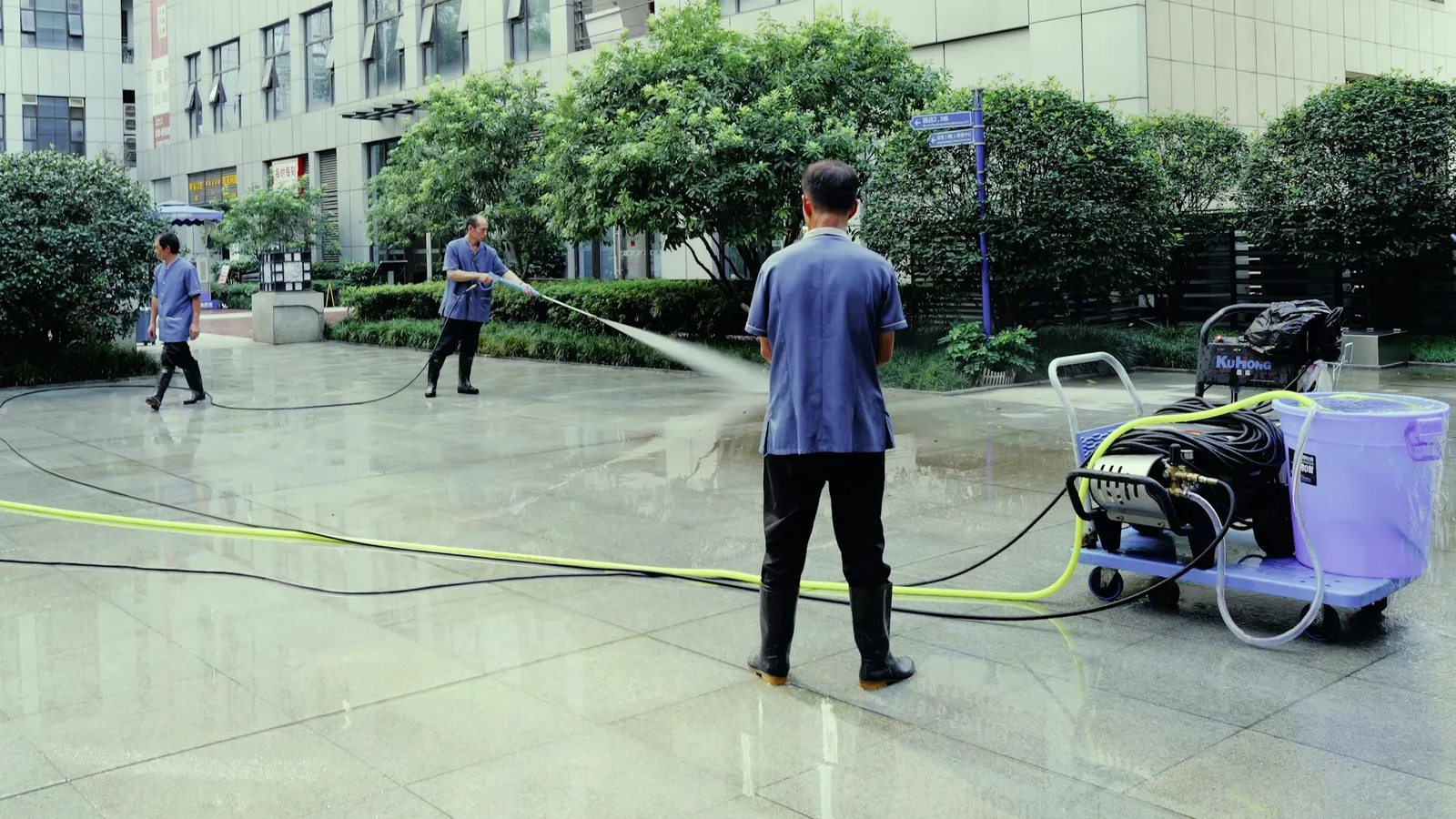
A 4 GPM pressure washer, a 20-inch surface cleaner and a Saturday morning can turn a $180 driveway job into 45 minutes of work. That arithmetic, roughly $200 an hour on site, is why so many people look up how to start a pressure-washing business. What most of them get wrong is buying the wrong machine (a $400 box-store unit that takes two hours to do that same driveway), pricing by the hour, and treating the business as concrete only when the real money is in house washing and roofs.
This guide is for anyone starting one in 2026, whether as a weekend side business from a pickup or a full-time company with a trailer rig. It covers the residential-versus-commercial choice, the licenses and wastewater rules that actually apply, insurance costs, a real equipment list at two budget levels, per-square-foot pricing that holds up, and how to book the first twenty jobs before your machine is paid off.
What a pressure-washing business actually looks like
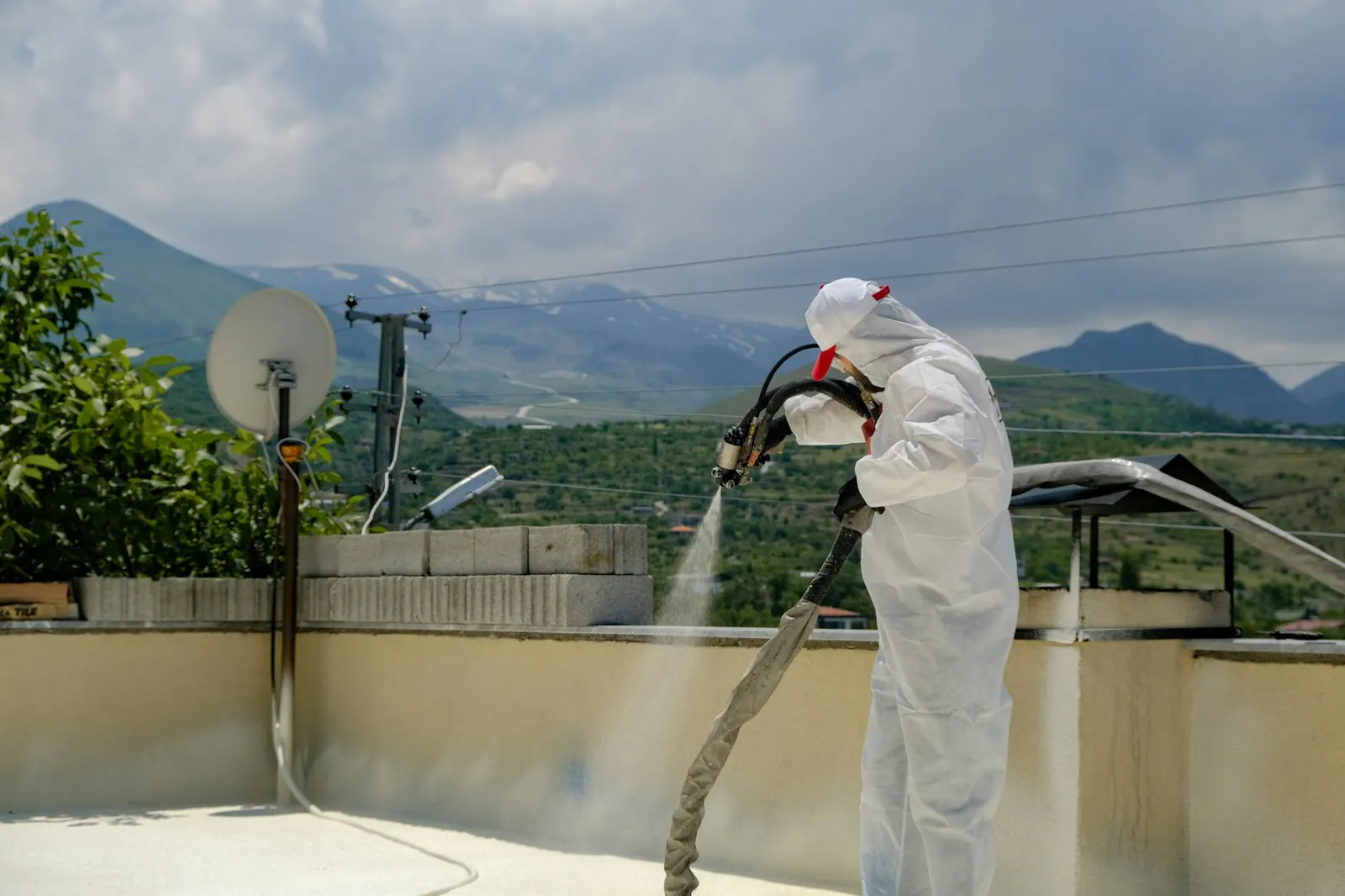
Your day starts early to beat the heat. First job by 7:30: pre-treat the driveway with a sodium hypochlorite mix, run the surface cleaner in overlapping passes, rinse, post-treat the mildew line along the garage, photograph the result. A driveway and walkway take 45 to 75 minutes. A house wash is two to three hours of soft washing: mixing, applying from the ground with a 12-volt pump, dwelling, rinsing, and rinsing the plants twice. Two to three jobs a day is a good solo pace.
Seasonality is the shape of the year. In the Southeast and Texas you can work ten to eleven months; in the Midwest and Northeast the season runs April through November, with spring and early fall as the two rushes. Prices cluster around $200 to $300 for a driveway, $400 to $600 for a house wash on a 2,000-square-foot home, and $800 to $1,500 for a roof. Homeowners in newer subdivisions holding HOA violation letters are the most reliable buyers in the country.
The people who thrive sell comfortably in person, respect chemicals and surfaces, and work their repeat list (a house needs washing every 18 to 24 months and a driveway yearly, so 300 customers is a business). What kills new operators is cheap equipment, one stripped deck that becomes a $2,000 claim without insurance, and no plan for the slow months.
Step 1: Pick your lane (residential, commercial, or soft wash first)
- Residential exterior cleaning. Driveways, sidewalks, patios, siding, decks, fences, roofs. Fastest to sell, paid on the spot, and the door-knocking model works because results are visible from the street. This is where almost everyone should start.
- Commercial flatwork. Shopping center sidewalks, drive-throughs, dumpster pads, parking garages, gas station pads. Monthly or quarterly contracts at $300 to $3,000 a visit, mostly at night, with hot water and wastewater recovery expected. Better as year-two work once you have a hot water rig.
- Fleet washing. Trucks and trailers at a yard, weekly, priced per unit ($25 to $60 for a tractor). Steady winter revenue, but requires water recovery and thin margins per unit.
- Roof and house soft washing. Higher ticket ($600 to $1,500 per roof), lower equipment cost, more chemistry knowledge. Many operators build the whole business around this because the margins beat concrete.
Start residential with driveways as the door-opener and house and roof washing as the upsell. A customer who called about a $220 driveway will often add a $450 house wash once you point out the algae on the north side.
Step 2: Legal setup: LLC, licenses, and the wastewater rule nobody tells you
Form an LLC before your first paid job. You will be spraying bleach solution 20 feet from a neighbor’s car with a machine that can strip paint; a sole proprietorship puts your house behind every mistake. Filing fees run $50 to $500 by state (most $100 to $200); file on your Secretary of State’s website. Get an EIN, open a business bank account, and register a DBA if your trade name differs.
Then check three things:
- Business license. Most cities and counties require one, $25 to $150 a year. Some also require a home-occupation permit if you store the trailer at home.
- Contractor licensing thresholds. Pressure washing itself is unlicensed in most states, but several treat exterior cleaning as contractor work above a dollar amount or when roofs are involved (Florida and California have thresholds; Louisiana and Mississippi have home improvement registrations). Search your state name plus contractor board and pressure washing, or call the board.
- Sales tax. Cleaning services are taxable in Texas, Ohio, Pennsylvania, New Mexico, Iowa, West Virginia and others. Get a sales tax permit there and add tax to invoices.
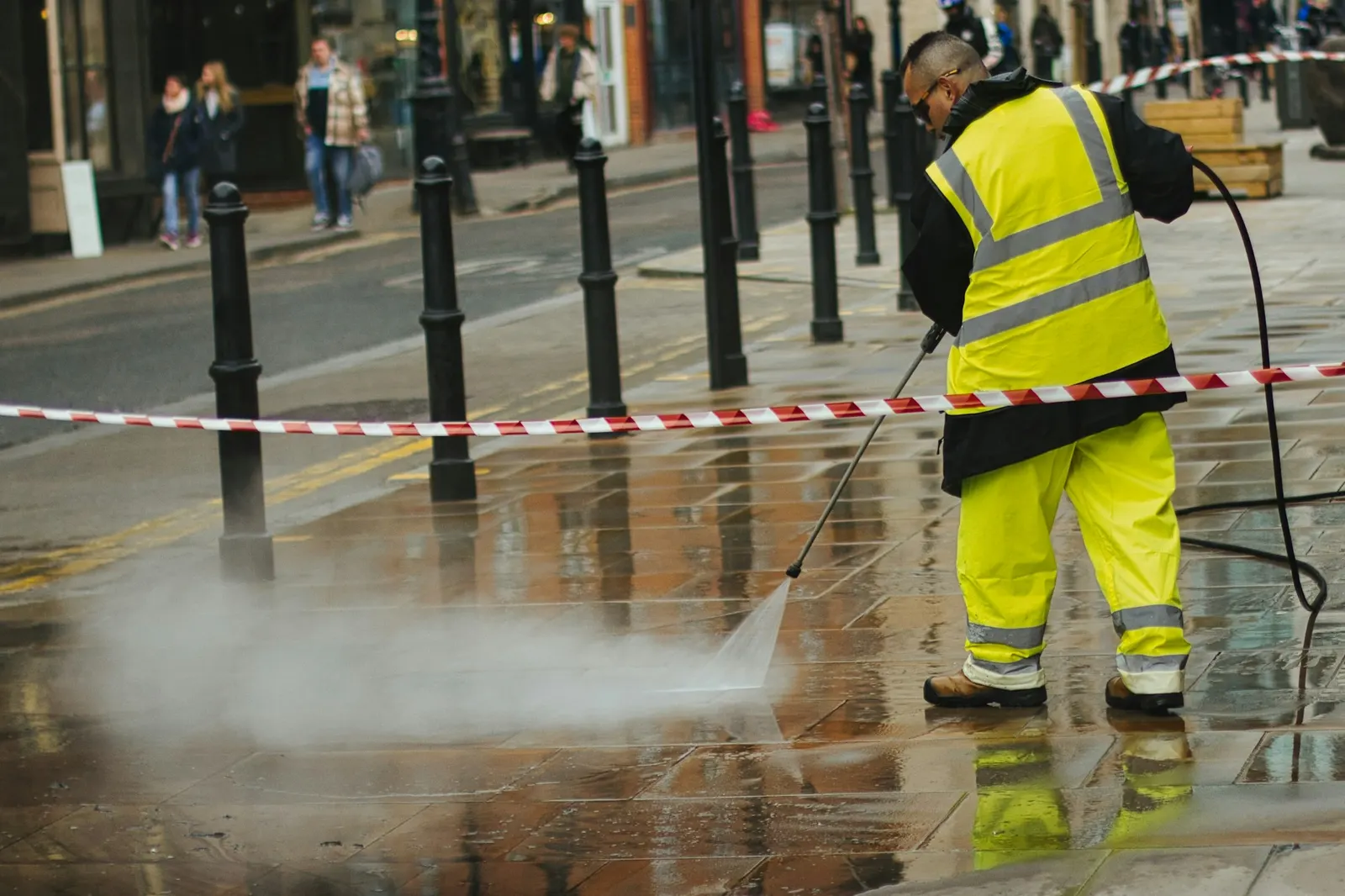
The rule that catches people is wastewater. Under the federal Clean Water Act and local stormwater ordinances, only rainwater may enter storm drains; runoff carrying degreaser or oil from a commercial pad is a violation, and cities fine contractors for it. Residential rinse water with diluted bleach is tolerated in most places because it neutralizes quickly, but commercial flatwork requires diverting water to landscaping or a sanitary cleanout, or recovering it with a vacuum. Call your city’s stormwater department once, ask what exterior cleaning contractors must do, and write down the answer.
Tip: Get your sodium hypochlorite from a pool supply store (12.5 percent, about $4 to $6 a gallon) rather than paying $10 a gallon for a “house wash” branded version of the same chemical.
Step 3: Insurance for pressure washing (and why base liability is not enough)
Pressure washing has a specific insurance problem: general liability covers damage to a neighbor’s car, but many policies exclude damage to the property you were working on. Your biggest realistic claim is exactly that: a stripped deck, etched glass, or a roof that leaked because the shingles were already failing.
| Coverage | What it covers | Typical annual premium |
|---|---|---|
| General liability ($1M/$2M) | Third-party injury and property damage | $600–$1,500 |
| Care, custody and control endorsement | Damage to the surface you are actually cleaning | $200–$500 added |
| Commercial auto (truck and trailer) | Accidents while towing your rig | $1,500–$3,000 |
| Inland marine / equipment | Theft or damage to machine, reels, trailer | $200–$500 |
| Workers’ compensation | Required with W-2 employees in almost every state | $3,000–$6,000 per $100,000 of payroll |
| Pollution liability (optional) | Chemical runoff claims on commercial jobs | $500–$1,500 |
Ask for the care, custody and control endorsement by name, and confirm that pressure washing and roof cleaning are listed as covered operations; some carriers exclude roofs. Joseph D. Walters, Next, and independent agents placing with Hiscox or Markel write a lot of this trade. Expect $80 to $200 a month for GL with the endorsement.
Step 4: Equipment and startup costs (with 2026 prices)
The machine is the decision that matters. Gallons per minute (GPM) cleans; PSI mostly damages things. A 4 GPM, 4,000 PSI belt-drive unit with a Honda GX390 engine is the entry point for a real business; an 8 GPM machine halves your time on concrete but needs a water tank and a trailer.
| Item | Lean start (pickup bed) | Full setup (trailer rig) |
|---|---|---|
| Pressure washer | 4 GPM / 4,000 PSI belt drive: $1,200–$2,000 | 8 GPM / 3,500 PSI, hot water option: $4,500–$9,000 |
| Surface cleaner (20–24 inch) | $250–$500 | $700–$1,200 (stainless, 4 nozzles) |
| Pressure hose (200 ft), wands, tips, quick connects | $250–$400 | $500–$800 |
| Soft wash system (12V pump, 50–100 gal tank, hose) | $400–$800 | $1,500–$3,000 (air diaphragm pump) |
| Water tank and float valve | — | $400–$900 (200–275 gal) |
| Trailer (6x12 single or tandem axle) | — | $2,500–$5,000 |
| Hose reels (pressure, supply, soft wash) | $200–$400 | $900–$1,800 |
| Chemicals (SH, surfactant, degreaser, oxalic acid) | $150–$250 | $400–$700 |
| Safety gear (respirator, goggles, gloves, bleach-proof boots) | $150–$250 | $250–$400 |
| Ladder, gutter tools, plant covers, tarps | $200–$400 | $400–$700 |
| LLC, license, first-month insurance | $250–$600 | $300–$700 |
| Vehicle magnets or trailer lettering | $60–$150 | $800–$2,000 |
| Website, Google Business Profile, door hangers | $150–$400 | $600–$1,500 |
| Total | $3,260–$6,150 | $13,750–$27,700 |
Buy the belt-drive machine from a pressure washing supplier, not a big-box store: the pump lasts ten times longer and can be rebuilt. Buy the trailer used, and do not buy a hot water unit until a commercial contract needs it.
Step 5: Pricing per square foot (and per job)
Quote per job from square footage and surface type, and never say your hourly rate out loud. Homeowners will happily pay $250 for a driveway and will not happily pay $200 an hour.
| Service | 2026 price range | Typical job | Time on site (solo, 4 GPM) |
|---|---|---|---|
| Driveway and walkway (concrete) | $0.15–$0.30 / sq ft | $180–$320 (900–1,200 sq ft) | 45–90 min |
| Patio, pool deck | $0.20–$0.35 / sq ft | $150–$350 | 45–75 min |
| House wash, vinyl or brick (soft wash) | $0.20–$0.40 / sq ft of siding | $350–$700 (1,800–2,500 sq ft home) | 2–3 hours |
| Roof soft wash (asphalt shingle) | $0.30–$0.75 / sq ft | $600–$1,500 | 2–4 hours |
| Deck or fence cleaning | $0.75–$1.50 / sq ft | $250–$600 | 1.5–3 hours |
| Gutter brightening (exterior) | $1–$2 / linear ft | $120–$250 | 30–60 min |
| Commercial sidewalk / storefront | $0.10–$0.20 / sq ft, $250 min | $300–$1,500 per visit | 1–4 hours (night) |
Set a $150 to $200 minimum so a tiny walkway is worth the drive. Bundling a driveway with a house wash at 10 percent off raises the average ticket from $250 to $600 with no extra travel. Price roofs high; the chemistry and the liability justify it, and a customer holding a roof-replacement quote considers $1,200 a bargain.
The math to a full-time income: 12 jobs a week at a $380 average ticket is $4,560 a week, about $18,000 a month in season. Fuel, chemicals and consumables run about $25 to $40 per job. The number that matters is revenue per hour on site, and it should sit between $125 and $200. If a job type consistently falls below $100 an hour, raise the price or stop offering it.
Watch out: Quote from measurements, not from the street. Pull the lot up on Google Maps, measure the driveway with the measurement tool, and ask for photos of the house sides. Quoting blind is how a “typical” driveway turns out to be 2,400 square feet of oil-stained brushed concrete.
Step 6: Get online and look legitimate
A homeowner who sees your truck on their street will look you up before they text. They need to find a website listing your services with starting prices (“driveways from $179, house washing from $349”), a before-and-after gallery of your own work, your service area, proof of insurance, reviews, and a fast way to request an estimate. Add a Google Business Profile with real photos and get five reviews in the first month by asking the moment the customer sees the clean driveway.
You can have Restart build the website: describe the business (services, area, starting prices, how you want people to reach you) and it builds the pages, writes the copy, designs the site and publishes it to a real URL. When you add roof cleaning or change prices, change it by asking. Use a dedicated business phone number, answer or text back within the hour (half of your leads will book the first company that replies), and run quotes and invoices through a simple tool like Jobber or Housecall Pro that takes cards on site. If you want to see what other small service businesses put online, that page shows examples.
Step 7: Book your first twenty jobs
The product sells itself from the curb; your first customers come from making that visible.
Door to door, the right way
Do your first job for a friend or neighbor at a fair price, then knock the surrounding fifteen houses that afternoon while the driveway is still glowing. The script is short: “I just did the Hendersons’ driveway across the street. I’m doing two more on this street this week and can do yours for $189 since I’m already here.” Neighborhood pricing converts 10 to 20 percent of doors in newer subdivisions. Leave a door hanger with a before-and-after at every no-answer.
Digital channels that work for this trade
Nextdoor and neighborhood Facebook groups love before-and-after photos; post one a week with a plain offer. Google Local Services Ads cost $25 to $60 per lead and convert well because the homeowner called you. Video of a surface cleaner peeling grime off concrete is genuinely watchable, and a $10-a-day boosted post aimed at zip codes with 1990s-and-newer homes reliably produces estimate requests. Thumbtack and Angi leads run $20 to $50 and convert around 15 percent; fine for a first month, expensive as a habit.
Partners
Realtors need driveways and siding cleaned before listing photos, property managers need move-out exteriors, and HOA management companies send the violation letters that generate your best leads. Drop a price sheet at ten realty offices and three HOA firms. Offer painters a referral fee; every exterior paint job starts with a house wash they would rather not do.
For the first five jobs: charge your neighborhood rate for driveways ($180 to $220), full price for house washes, and ask for a Google review and permission to post photos before you pack the hose.

Step 8: Operate, smooth the seasons, then add a second rig
Systems. A written procedure for each service with dilution ratios (house wash at roughly 1 to 2 percent SH, roofs at 3 to 6 percent), plant protection steps, and a photo checklist: before, after, and close-ups of pre-existing cracks, oxidation and loose screens. That habit ends most disputes before they begin.
Contracts and deposits. Residential jobs use a written estimate accepted by text and paid by card on completion. Commercial and roof jobs get a signed agreement and a 25 to 50 percent deposit. Add a clause on pre-existing conditions and oxidized vinyl siding, which can show streaks after cleaning that were already there.
The slow months. Sell maintenance plans in the fall (driveway yearly, house every two years, 10 percent off) so spring is booked before it arrives. Add gutter cleaning, holiday lighting or commercial night work for winter revenue. Some operators pair this with window cleaning or gutter cleaning because the customer list and the ladder are the same.
Hiring and the second rig. A first helper at $18 to $25 an hour halves house-wash time and adds about 40 percent to daily capacity. The second rig comes when you book 18 to 20 jobs a week consistently; it costs $10,000 to $15,000 and needs a crew lead you trust with chemicals and customers. What breaks at 2x is quoting and scheduling, not cleaning: plan two hours a day on the phone and take yourself off the route one weekday.
How much can you make?
Figures for a mid-cost US market in season. Costs include fuel, chemicals, insurance, software, equipment wear and marketing, and exclude income taxes.
| Level | Volume | Monthly revenue | Monthly costs | Monthly profit |
|---|---|---|---|---|
| Side income (Saturdays + 2 evenings) | 5 jobs/week at $300 avg | $6,000–$6,500 | $900–$1,300 | $5,000–$5,500 |
| Full-time solo | 12 jobs/week at $380 avg | $17,000–$19,500 | $2,500–$3,500 | $14,500–$16,000 |
| Two rigs (you + 2 crew) | 28 jobs/week at $420 avg | $45,000–$52,000 | $24,000–$30,000 | $18,000–$24,000 |
Multiply by eight or nine in-season months, not twelve, unless you are in the Sun Belt: a full-time solo operator in Ohio clears about $110,000 to $130,000 a year before taxes; the same operator in Florida can push $150,000. The solo ceiling is your body and daylight. Beyond that, profit comes from a second and third rig with crews, where $250,000 to $400,000 in owner income is realistic.
Mistakes that sink new pressure-washing owners
- Buying a box-store machine. A 2.5 GPM direct-drive unit turns a 45-minute driveway into two hours and dies in a season. Fix: a 4 GPM belt-drive from a pressure washing supplier, even used.
- High pressure on siding, decks and roofs. Stripped paint, furred wood, voided roof warranties, water behind the siding. Fix: soft wash anything that is not concrete or brick.
- Killing the landscaping. Bleach solution browns plants in a day. Fix: pre-wet everything, rinse plants during and after, and neutralize with a plant wash.
- Quoting by the hour or from the street. Fix: measure on Google Maps, ask for photos, quote per job with a minimum.
- No care, custody and control coverage. Your most likely claim is excluded from base liability. Fix: ask for the endorsement by name before job one.
- Treating it as a concrete business. Driveways alone are a $200 average ticket. Fix: sell the house wash and the roof; they double the ticket for the same trip.
- No plan for winter. Operators quit in February. Fix: sell maintenance plans in October, add gutters or commercial night work, save 20 percent of summer revenue.
Your first 30 days
Week 1
- Decide residential-first with driveways as the opener and house washing as the upsell.
- File the LLC; get an EIN; open a business bank account; check city license, contractor thresholds and sales tax.
- Call your city stormwater department and ask what exterior cleaning contractors must do with runoff.
- Bind general liability with the care, custody and control endorsement.
- Build the website on Restart with services, starting prices and a free-estimate form; claim your Google Business Profile.
Week 2
- Buy the lean rig: 4 GPM belt-drive machine, surface cleaner, hoses, 12V soft wash pump, chemicals, safety gear.
- Practice on your own driveway, a relative’s siding and a fence until your passes leave no stripes.
- Write dilution ratios and a before-and-after photo checklist; set prices and minimums.
- Set up a business phone number and a quoting tool that takes cards on site.
Week 3
- Do two or three jobs for friends or neighbors at a fair price; photograph everything; collect three Google reviews.
- Knock the fifteen houses around each job the same afternoon with a neighborhood price; leave door hangers.
- Post before-and-afters in three neighborhood Facebook groups and on Nextdoor.
- Drop price sheets at ten realty offices and three HOA management companies.
Week 4
- Reply to every lead within the hour; quote from measurements and photos.
- Aim for ten booked jobs and at least two house washes sold as add-ons.
- Start a customer list with service dates for next year’s reminders.
- Review the month: revenue per hour by service, which channel produced each job, and what to charge more for.