A professional window cleaner with $500 of tools can clean a 20-window house in about two hours and bill $300 for it. That ratio of equipment cost to hourly earnings is why window cleaning is one of the few home services you can start with a paycheck’s worth of savings and be profitable on the first job. It is also why plenty of people who look up how to start a window-cleaning business try it, do a few jobs at $99, and quit before they learn the parts that matter: pricing, routes, and getting the same customer back twice a year.
This guide covers how to start a window-cleaning business from an empty garage to a booked calendar: the actual equipment (and what to skip), how residential and storefront pricing really work, what insurance a landlord will demand before you touch their glass, and where the first customers come from. It is written for a solo operator or a two-person team in the US, whether you want a side business on weekends or a full route that replaces a job.
What a window-cleaning business actually looks like day to day
A residential day is two to four houses. You arrive around 8:30, walk the exterior with the homeowner, confirm the count and extras, then work in a fixed pattern: screens off and washed, exterior glass with a pole or ladder, interior glass with a scrubber and squeegee, tracks and sills wiped, screens back on. A 25-window two-story home with screens takes a solo cleaner two and a half to three and a half hours. You collect payment on the spot, ask for a review, and book the next visit before you leave.
A commercial day is a route: fifteen to thirty storefronts, five to twenty minutes each, billed monthly at $25 to $60 a visit. Storefront work is low-paid per stop but predictable, and it carries the business through January when nobody wants their house done. The people who last build both: residential for margin, commercial for stability.
Two market signals worth knowing. First, a typical residential job in a mid-cost metro prices at $250 to $450, and the customer who pays it once will pay it again in six months if you ask. Second, in most of the country demand runs in two waves, March through June and September through November, so your marketing spend should be front-loaded in late winter. If you live in Phoenix or Tampa, the season is nearly year-round; if you live in Minneapolis, plan for three thin months.
The work is physical but not brutal: ladders daily, hours on a pole, wet sleeves. People who thrive like visible, finished results and are comfortable talking to homeowners about money. What kills these businesses is not lack of skill. It is underpricing, no follow-up system, and a truck full of work in May with nothing in December.
Step 1: Choose residential, commercial, or both
Start by deciding what your first ninety days look like, because the two halves of this trade need different marketing and slightly different tools.
Residential means single-family homes, often 15 to 40 windows, priced per job with a $150 to $250 minimum. Margins are highest, customers care about interior glass and screens, and word of mouth in a neighborhood compounds. The downside is seasonality and one-off customers unless you build a reminder system.
Storefront commercial means retail strips, restaurants, salons, banks, and dental offices, cleaned exterior-only every one, two, or four weeks. Pricing is $20 to $60 a visit for small shops, $80 to $250 for larger glass-heavy locations like car dealerships. A route of 40 stops billing $35 every two weeks is $3,000 a month of recurring revenue that you can clean in about three mornings.
Mid-rise commercial (three to six stories) needs water-fed poles up to 60 feet, fall-protection training, higher insurance limits, and patience with property managers. It pays well but is not a day-one market.
Most successful new operators start residential for cash flow, then build a storefront route in the same neighborhoods during the slow season.
Step 2: Set up the legal side
There is no license specifically for window cleaning anywhere in the US. What you need is ordinary small-business paperwork, and it takes an afternoon.
- Entity. Form a single-member LLC in your state ($50 to $500 depending on the state; California adds an $800 annual franchise tax). You are working on ladders at other people’s homes, so the liability separation is worth having from day one. A sole proprietorship with a DBA works if you truly want to test for a month first.
- EIN. Free from the IRS website in ten minutes. You need it to open a business bank account and to hire.
- Business license. Most cities or counties require a general business license or registration, typically $25 to $150 a year. Search “[your city] business license” and check whether your county has a separate requirement.
- Sales tax. A minority of states tax cleaning services (Texas, Ohio, New Mexico, and a handful of others). Check your state department of revenue’s page on taxable services; if window cleaning is taxable where you are, register for a sales tax permit before your first invoice.
- Bank account and card. Open a business checking account so every job payment and every squeegee rubber lands in one place.
Tip: Set up a free Google Business Profile the same day you file the LLC. Verification can take a week or two by postcard or video, and you want it live before your first customers go looking for reviews to leave.
Certifications worth having
None are required, but two help you sell commercial work. The International Window Cleaning Association (IWCA) offers safety training that property managers recognize. If you plan to clean above two stories on commercial buildings, OSHA fall-protection rules apply, and a documented one-day safety course ($150 to $400) is both a legal shield and a sales tool.
Step 3: Get the right insurance
Insurance is the credential that matters in this trade. Every property manager and most homeowners will not let you work without a certificate of insurance, and one dropped ladder through a bay window can cost more than your first year’s profit.
| Coverage | What it covers | Realistic annual premium |
|---|---|---|
| General liability ($1M/$2M) | Broken glass, scratched frames, water damage, a customer tripping on your hose | $450–$1,200 |
| Commercial auto or hired/non-owned | Your work vehicle, or a personal vehicle used for work | $1,200–$2,500 (commercial); $200–$500 (HNOA rider) |
| Inland marine / equipment floater | Poles, filters, and tools stolen from the truck | $150–$400 |
| Workers’ compensation | Required in most states once you hire a W-2 employee | $2,500–$6,000 per $100,000 of payroll |
Buy general liability first; it is the one clients ask about. Call your personal auto insurer and tell them you use the vehicle for business, because a personal policy can deny a claim if the vehicle was working. Add workers’ comp the week before your first hire, not after.
Step 4: Buy equipment (and know what to skip)
Professional window cleaning is a low-equipment trade, and buying the right $500 of tools is more important than buying $5,000 of everything. Professional brands (Ettore, Unger, Moerman, Sörbo, Pulex) cost two to three times what the hardware store sells and last ten times longer.
| Item | Lean start | Full setup |
|---|---|---|
| Squeegees (14”, 18”, channels, rubber) | $80 | $200 |
| Scrubber/T-bar and sleeves | $40 | $90 |
| Extension pole (8–24 ft) | $60 | $150 |
| Bucket, belt, holsters, scrapers, blades | $70 | $150 |
| Ladders (24 ft extension, 6 ft step, standoff) | $350 | $700 |
| Towels, huck cloths, solution, drop cloths | $60 | $120 |
| Water-fed pole (30–45 ft) and brush | — | $700–$1,500 |
| Pure-water system (DI tank or RO/DI cart) with TDS meter | — | $600–$2,500 |
| Screen cleaning kit and hard-water remover | $40 | $150 |
| Vehicle magnets or partial wrap, uniforms | $100 | $800 |
| LLC, license, insurance down payment | $400 | $900 |
| Total | $1,200 | $5,700–$7,800 |
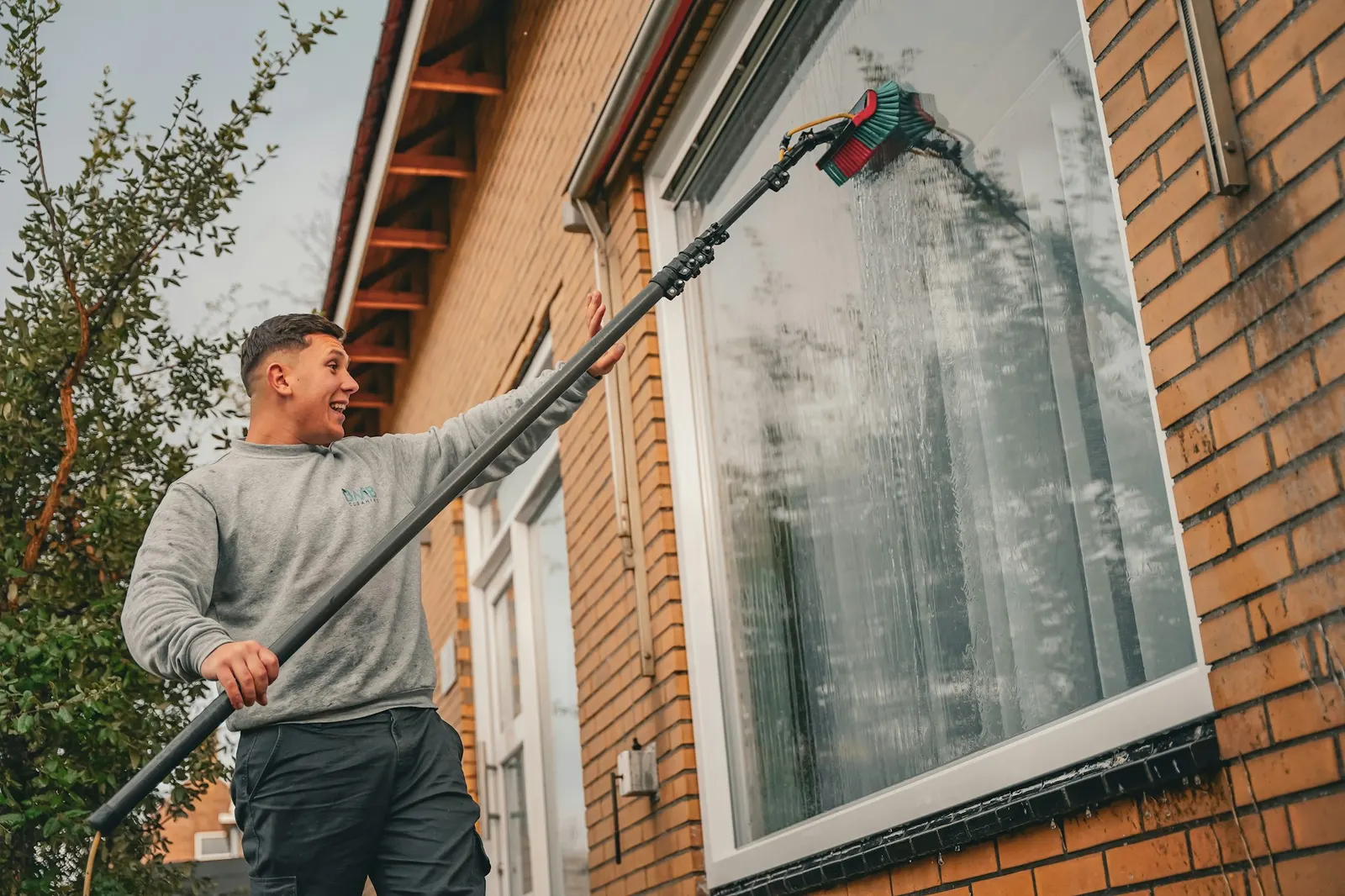
The water-fed pole is the one purchase that changes the business. Deionized water flows through a brush on a carbon-fiber pole, you clean second- and third-story exteriors from the ground, and the glass dries spot-free because pure water leaves no minerals behind. A DI-only tank works where tap water is soft (under about 100 ppm on a $15 TDS meter); harder water burns through resin and calls for a combined RO/DI cart. You do not need a truck; a hatchback or SUV holds everything.
Step 5: Set your pricing
Window cleaning is priced by the pane on residential jobs and by the visit on commercial routes. The number to hold in your head is your target hourly rate, which for a solo professional should be $75 to $125 an hour including drive time. Every quote is a guess at how long the job takes, converted to dollars.
Residential pricing
Walk the house and count. A “window” is one standard pane or double-hung unit; French panes, oversized picture windows, and skylights get counted higher or added as extras.
| Service | Typical price (2026) |
|---|---|
| Standard window, inside and out | $8–$15 each |
| Standard window, exterior only | $4–$8 each |
| French pane / divided-light window | $2–$4 per pane, or 1.5–2× a standard |
| Screen wash | $2–$5 each |
| Tracks and sills detail | $1–$3 per window |
| Skylight | $20–$40 each |
| Hard-water stain removal | $15–$40 per pane |
| Job minimum | $150–$250 |
A 24-window two-story with screens, in and out, prices around $300 to $420 in a mid-cost metro and takes two and a half to three hours solo. That is $100 to $150 an hour before overhead. Quote high-end neighborhoods at the top of the range; they expect it and they refer more.
Commercial route pricing
Storefronts are priced by the visit: minutes of glass times your hourly rate, with a floor. A single-door boutique with four panes is $20 to $30 every two weeks; a restaurant with 18 panes is $45 to $70; a dealership showroom is $200 to $500 monthly. Price the frequent option lower per visit; a shop paying $30 biweekly is worth more than one paying $50 monthly, because the glass stays easy and you are in the neighborhood twice as often.
The monthly math
Three residential jobs a day at $320 average, four days a week, is about $15,000 a month in season. That is a solo ceiling, not a starting point; a realistic first spring is one to two jobs a day. A commercial route of 40 stops at $35 biweekly adds $2,800 a month that shows up whether or not the phone rings.

Step 6: Get online and look legitimate
Homeowners who search “window cleaning near me” pick from the map pack and decide in about ten seconds whether you look like a real company. That means a Google Business Profile with photos and reviews, a website that answers their questions, and a phone number a human answers or returns within an hour.
Your website needs five things: the services you offer (residential, storefront, screens, tracks, hard-water removal), starting-at prices or a clear “from $150” minimum so tire-kickers self-select out, your service area by town or neighborhood, before-and-after photos of your actual work, and a request-a-quote form that asks for address, number of windows, and stories. Add your insurance status and a few reviews as they arrive. That is it; a window-cleaning site does not need a blog.
You can have Restart build it: describe the business, your services, area, pricing, and how you want people to reach you, and it builds the pages, writes the copy, designs the site, and publishes it to a real URL. When you add a water-fed pole and start taking three-story jobs, change the services page by asking. Other service businesses built this way tend to launch with a quote form and a pricing page as the two pieces that do the most work.
On Google Business Profile, choose “Window cleaning service” as the primary category, upload ten or more real photos in the first week (your vehicle, your tools, a squeegee mid-stroke, finished glass), and ask every customer for a review on the spot with a QR code on your invoice. Fifteen reviews with a 4.9 rating will put a new operator above ten-year-old companies that never asked.
Step 7: Get your first customers
The first ten jobs come from people who already know you or already see you. Spend nothing on ads until you have done twenty jobs and have photos and reviews to show.
- Your own neighborhood. Clean your own windows, your neighbors’ for $99 with a review requested, and put a yard sign in each front lawn for the day. Door hangers on the surrounding fifty houses convert at one to three percent when they show a price (“Two-story homes from $249”).
- Nextdoor and neighborhood Facebook groups. Post before-and-after photos with a plain offer, not a pitch. Answer every “anyone know a window cleaner?” thread within an hour.
- Realtors and stagers. Listings need clean glass for photos. Offer a flat-rate pre-listing exterior clean ($150 to $250) and a fast turnaround. One busy agent can send you three jobs a month.
- Adjacent trades. Pressure-washing, gutter-cleaning, and house-cleaning companies constantly get asked about windows and rarely do them. Trade referrals; a 10 percent finder’s fee is standard. If you are still deciding between trades, pressure washing and gutter cleaning pair naturally with window work on the same customer and the same visit.
- Storefront walk-ins. Pick a retail strip, walk in with a card between 9 and 11 a.m. on a weekday, ask for the manager, and offer a free first clean of the front door glass. Aim for 30 walk-ins a morning; you will land three to six recurring accounts.
- Thumbtack, Angi, and similar lead sites. Leads cost $15 to $40 and close at 20 to 40 percent, so a $300 job might cost $75 in leads. A bridge, not a habit.
For your first five residential jobs, price at the low end of the ranges in Step 5 but never below your minimum, and say this: “I’m newly launched in the area, fully insured, and I’m building my reviews, so I’d like to earn yours.” Ask for a review before you drive away, and text a photo of the finished glass along with the invoice.
Watch out: Do not offer free interior cleaning or unlimited “touch-ups” to win a job. Homeowners who choose you for free work will not pay full price next time, and your calendar fills with the wrong customers.

Step 8: Run the operation and scale it
The window-cleaning businesses that grow past one person all have a reminder system. A homeowner who paid $340 in April will pay $340 in October if you text them in September. Put every residential customer on a six-month (or quarterly for high-end homes) reminder the day you finish the job. A recurring residential base of 200 homes cleaned twice a year at $320 is $128,000 a year with almost no marketing.
Scheduling. Cluster residential jobs by neighborhood and day; run commercial routes on fixed weekdays in fixed order so shop owners expect you. Leave a 30-minute buffer between houses. Field-service apps (Jobber, Housecall Pro, and similar) handle quotes, reminders, and invoicing for $50 to $150 a month once volume justifies it; a calendar and a spreadsheet work for the first fifty customers.
Contracts and deposits. Residential does not need deposits; you collect on completion by card, Zelle, or check. Commercial accounts should sign a simple one-page service agreement stating frequency, price per visit, monthly billing, and a 30-day cancellation term, and you invoice monthly with net-15 terms.
Hiring your first helper. When you are booking more than three houses a day, hire. A trained helper at $18 to $25 an hour lets you run two houses at once in the same neighborhood and finish each faster. Train on your jobs for two weeks before sending anyone solo, and buy workers’ comp first. At two people you can gross $20,000 to $25,000 a month in season; the things that break are quality (streaks and missed tracks show up as one-star reviews) and cash flow (you now have payroll on Friday whether or not it rained Tuesday).
Second unit. A second vehicle, pole system, and crew costs $6,000 to $10,000 to outfit. Do not add it until the first crew is booked four weeks out and your storefront route can cover both crews’ winter wages.
How much can you make?
Supplies run under 3 percent of revenue. The real costs are fuel, insurance, marketing, and (later) payroll. These scenarios assume a mid-cost US metro and in-season residential demand; average across the year for cold climates by cutting residential revenue in December through February by half or more.
| Scenario | Work volume | Monthly revenue | Monthly costs | Monthly profit |
|---|---|---|---|---|
| Side income (Saturdays) | 6 homes/month at $300 | $1,800 | $300 (fuel, supplies, insurance share) | $1,500 |
| Full-time solo | 40 homes/month at $320 + 30-stop biweekly route at $35 | $14,900 | $2,400 (fuel, insurance, software, leads, supplies) | $12,500 |
| Small team (you + 2, two vehicles) | 90 homes/month at $330 + 80-stop route | $35,300 | $17,500 (payroll $12k, vehicles, insurance, marketing) | $17,800 |
Annualized, full-time solo lands most operators at $60,000 to $110,000 of profit depending on climate and how well they fill the off-season with commercial work. The small-team scenario looks like $150,000 to $200,000 a year in owner profit, but it comes with a payroll and a phone that rings at 7 a.m. The ceiling for a one-owner window-cleaning company is usually three or four crews before it needs a real office manager, which is when it stops being a trade and becomes a management job.
Mistakes that sink new window-cleaning owners
- Pricing to win every job. New cleaners quote $5 a window and fill their calendar with $120 jobs that take three hours. Fix: set a $150 to $250 minimum, quote from your hourly target, and let cheap customers hire someone else.
- No reminder system. They clean 150 houses in year one and start year two at zero. Fix: put every customer on a six-month text reminder the day the job ends.
- Ignoring commercial work until January. Residential dries up and there is nothing to do. Fix: walk storefronts in October and November; a 30-stop route funds the winter.
- Cheap tools. Hardware-store squeegees leave streaks, which produce redo visits and bad reviews. Fix: buy professional brands and replace rubber weekly.
- Skipping the walkthrough. They quote from the curb, miss the sunroom and the French doors, and eat two extra hours. Fix: count every pane with the customer present and confirm extras before starting.
- Working uninsured “for now.” One cracked pane on a $2,000 picture window ends the business. Fix: buy general liability before the first paid job; it costs less than one job a month.
- Ladders on wet decks and uneven ground. Fix: a standoff, levelers, and the rule that above the second story you use a pole.
Your first 30 days
Week 1
- File the LLC, get the EIN, open the business bank account, and apply for your city business license
- Get general liability quotes from two or three insurers and bind the policy
- Order the lean kit from a professional supplier; watch technique videos and practice on your own windows until there are no streaks
- Claim and start verifying your Google Business Profile
- Build the website on Restart: services, starting-at prices, service area, quote form
Week 2
- Clean two or three homes for friends and neighbors at your minimum price; photograph everything
- Ask each for a Google review before you leave
- Order door hangers with a price and your phone number; print a QR code for reviews on your invoices
- Set your price list and job minimum; write your one-page commercial service agreement
Week 3
- Door-hang 200 homes around your completed jobs; post before-and-afters in two neighborhood groups
- Spend two mornings walking storefronts and pitching a free first door-glass clean
- Introduce yourself to three realtors and two pressure-washing or gutter companies
- Upload ten photos to Google Business Profile
Week 4
- Aim for eight to twelve paid jobs this week between residential and new storefront accounts
- Put every finished customer on a six-month reminder
- Review your hours against revenue; adjust pricing if you are under $75 an hour
- Decide whether the water-fed pole purchase is justified by the two-story jobs you have quoted