A vending machine in a good location grosses about $400 a month. That number, not the machine price, is the one to build your plan around, because it means one machine is a hobby, ten machines is a serious side income, and thirty machines is a full-time living that takes about twenty hours a week to run. Beginners working out how to start a vending-machine business get the order backwards: they buy a machine first and then go looking for somewhere to put it, which is how a $4,000 combo unit ends up in a garage or in a laundromat that produces $60 a month.
This guide is for anyone working out how to start a vending-machine business in 2026, whether as one machine in a friend’s warehouse or a 30-machine route across a metro area. It covers the types of machines and what they earn, the licenses and sales tax rules that apply to vended food, insurance, real 2026 machine and product costs, pricing and margins per item, how to land locations (the whole game), and what running a route looks like at 5, 15 and 30 machines.
What a vending-machine business actually looks like
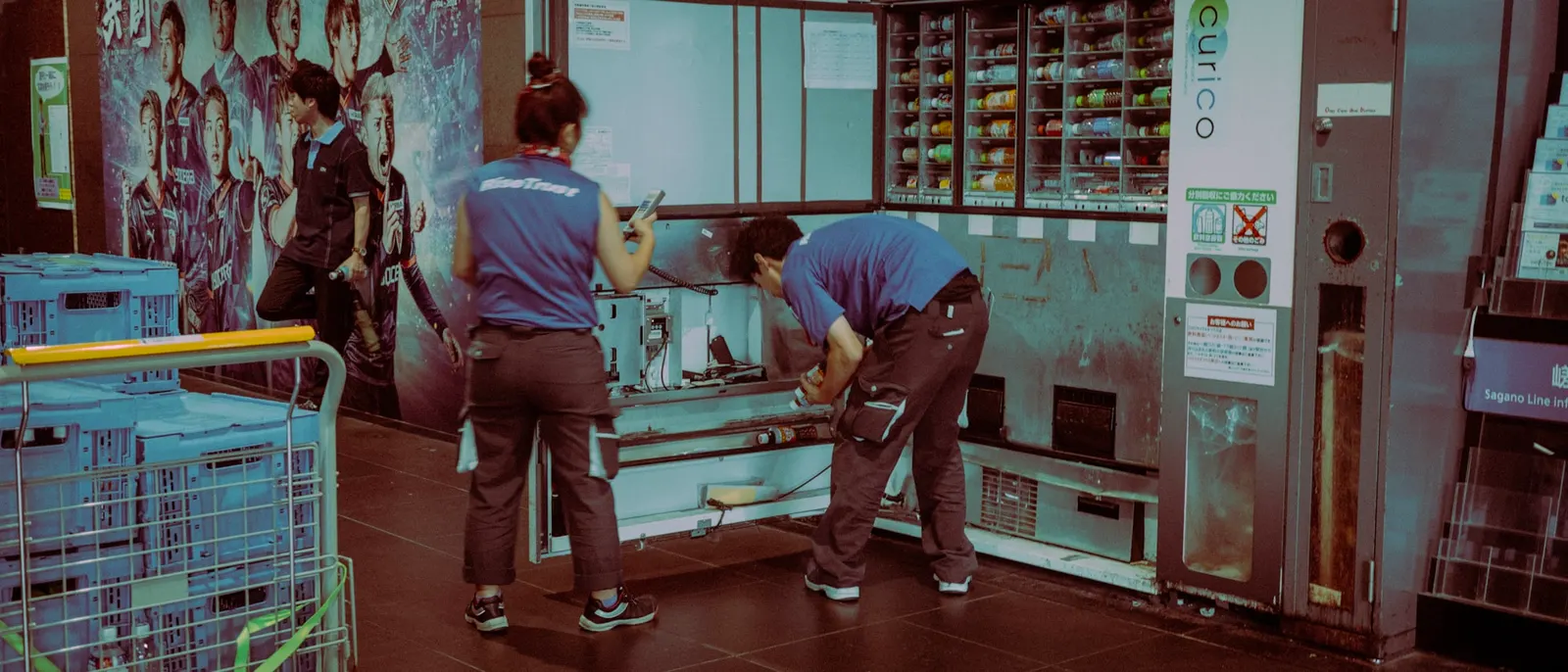
The work is a route. Once a week or so you load a van or SUV with cases from Sam’s Club, Costco or a vending distributor, drive to each machine, check the card reader’s sales report, fill what sold, rotate anything near expiry, wipe the glass, count the cash, and move on. A stop takes 20 to 40 minutes including driving; thirty machines is two or three route days a week. Between routes you answer the occasional “machine ate my dollar” text, fix a coin jam, and knock on doors for the next location.
Product margins are good (a bag of chips costs $0.45 and sells for $1.50) but revenue per machine is small, so the business is volume and placement. The same machine grosses $150 a month in a 20-person office and $1,200 in a 24-hour distribution center with 300 workers and no nearby food. Operators who make real money spend most of their effort finding the second kind of location and pulling machines out of the first kind within 90 days.
Two market signals. Card readers lifted sales 20 to 35 percent for most operators who added them, and card now exceeds cash at most machines. And the hosts most eager for machines are employers who lost a cafeteria or catering budget and apartment complexes competing on amenities. What kills new vending businesses is buying machines before locations, overpaying for a route with inflated sales claims, and letting weak locations sit for a year.
Step 1: Choose your machine type and niche
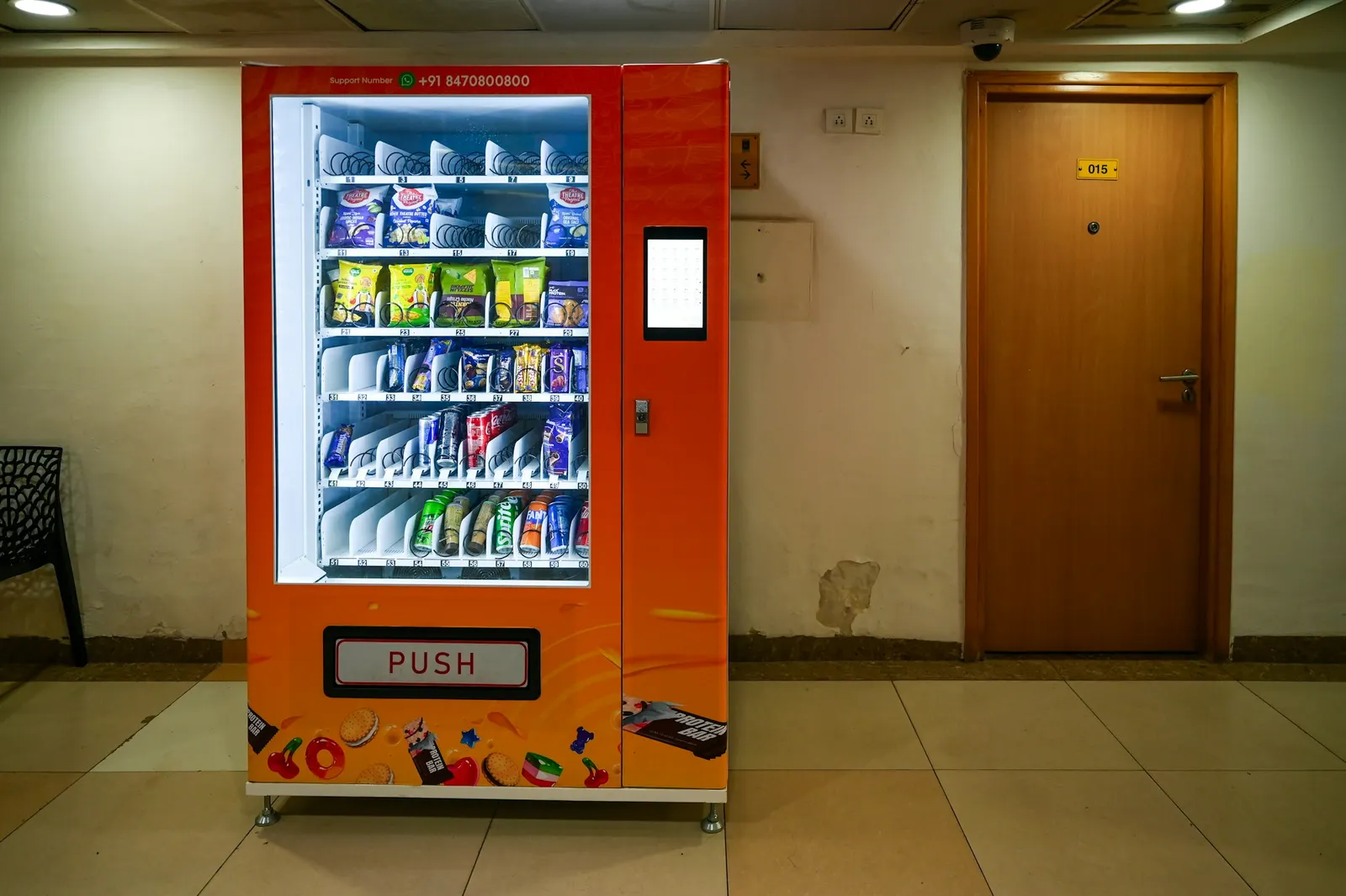
- Snack and drink (traditional). Separate or combo machines with chips, candy, pastries and canned or bottled drinks. Highest volume, best-known, most competition. Combo machines save floor space but have less capacity per category.
- Healthy vending. Same machines, different product (protein bars, nuts, sparkling water). Sells well in gyms, hospitals and schools that have nutrition rules, and worse in warehouses. Margins are similar; spoilage is higher.
- Drink-only. Simplest to run and highest margin on bottled water; strong in gyms, car washes, hotels and pools.
- Specialty and micro-markets. Coffee, ice cream, fresh food, PPE and phone accessories, or an unattended micro-market (open shelves with a self-checkout kiosk) for offices over 150 people. Higher ticket and higher equipment cost ($10,000 to $25,000 for a micro-market); best once you have a few strong accounts.
- Bulk candy and toy machines. $1 to $2 turns of gumballs and capsules at $0.25 to $1. Cheap machines ($100 to $400), tiny revenue ($20 to $80 a month), useful mostly as a low-cost way to learn locating.
Start with refurbished snack and drink machines with card readers, placed in workplaces; every skill transfers to specialty machines later.
Step 2: Legal setup: LLC, sales tax, and per-machine licenses
Form an LLC ($50 to $500 to file, most states $100 to $200), get a free EIN, and open a business bank account. Locations expect an LLC name on the placement agreement and the machine decal.
Then handle three requirements that vending specifically triggers:
- Sales tax permit. Vended food and drinks are taxable in most states, often at a special rate or with rules about whether tax is included in the posted price. Register with your state Department of Revenue, and ask specifically how vending sales are reported; several states let you remit on a percentage of gross receipts rather than per item.
- Vending machine license or decal. Some states, counties and cities require a license per machine, usually $10 to $100 a year (Maryland and Pennsylvania have state-level requirements; many Texas cities and Florida counties license machines locally). Search your state and city name plus vending machine license.
- Health permit. Machines selling perishable or refrigerated food (sandwiches, milk, yogurt) typically need a food establishment or vending permit from the county health department, plus temperature controls that shut off sales if the machine warms. Shelf-stable snacks and sealed drinks usually do not, but confirm with the health department.
Also know that K-12 schools follow federal Smart Snacks nutrition rules and federal buildings give priority to blind vendors under the Randolph-Sheppard program. Neither rules those locations out, but you need to know before you pitch.
Tip: Ask your state Department of Revenue whether posted prices must include sales tax. In many states you can price at $1.50 tax-inclusive and back the tax out when you file, which is much simpler than a machine that charges $1.62.
Step 3: Insurance for a vending route
Location owners will ask for a certificate of insurance before they let a 700-pound machine onto their floor. Vending is a low-claim trade, so premiums are modest.
| Coverage | What it covers | Typical annual premium |
|---|---|---|
| General liability ($1M/$2M) | A machine tips on someone, a slip on a spilled drink, product liability claims | $400–$900 |
| Inland marine / equipment | Theft, vandalism or damage to machines at locations and in transit | $300–$800 for a 10-machine route |
| Commercial auto or hired/non-owned | Accidents on the restocking route; personal auto often excludes business use | $1,200–$2,500 (commercial); $150–$400 (HNOA) |
| Product spoilage (optional) | Loss of refrigerated inventory in a power outage | $100–$300 |
| Workers’ compensation | Required with W-2 employees in almost every state | $1,500–$3,000 per $100,000 of payroll |
Buy general liability before your first placement. Next, Hiscox, Thimble and Biberk quote small routes online; ask for the location to be named as an additional insured, which most carriers do free. Anchor machines to the wall where the location allows it; a tipping machine is the one serious liability in this business.
Step 4: Machines, product and startup costs (2026 prices)
Buy refurbished. A reconditioned machine from a vending equipment dealer costs half of new, comes with a 30- to 90-day warranty, and lasts another decade. Marketplace and Craigslist machines run cheaper but you inherit whatever is wrong with them; a bad bill validator alone is $200.
| Item | Lean start (2 machines, own SUV) | Full setup (5 machines, cargo van) |
|---|---|---|
| Snack machine, refurbished (new $3,000–$5,000) | $1,500–$2,500 | $1,500–$2,500 each |
| Drink machine, refurbished (new $3,500–$6,000) | $1,800–$3,000 | $1,800–$3,000 each |
| Combo machine, refurbished (new $4,000–$7,000) | — | $2,500–$4,000 |
| Card reader + telemetry (Nayax, Cantaloupe) | $200–$400 each, $8–$12/mo | $200–$400 each |
| First product fill | $200–$300 per machine | $200–$300 per machine |
| Hand truck / appliance dolly with straps | $150–$400 | $500–$1,200 (stair-climbing) |
| Used cargo van | — | $8,000–$18,000 |
| Machine delivery (if not moving yourself) | $150–$400 per machine | $150–$400 per machine |
| LLC, EIN, sales tax permit, machine licenses | $200–$500 | $300–$800 |
| Insurance (first year) | $500–$1,000 | $1,500–$3,500 |
| Website, business cards, location flyers | $100–$300 | $300–$1,000 |
| Total | $5,200–$9,600 | $26,000–$50,000 |
Two rules on equipment. Insist on a machine with an MDB connector so it accepts a modern card reader (most made after about 2005 do; older ones retrofit for $100 to $200). And favor machines with a guaranteed delivery sensor, which re-vends when a product hangs; refund complaints are the main way you lose a location’s goodwill. Product comes from club stores for the first ten machines; past that, a vending distributor such as Vistar delivers at slightly better prices in vending-friendly case sizes.
Step 5: Pricing and margins per item
Vending prices have moved up sharply since 2021; in 2026 nobody blinks at $1.75 chips or $2.25 sodas in a workplace. Price to a 50 to 60 percent margin, then round to the nearest quarter.
| Item | Your cost (club store, 2026) | Typical vend price | Gross margin |
|---|---|---|---|
| Chips, 1–1.5 oz bag | $0.40–$0.55 | $1.50–$1.75 | 65–72% |
| Candy bar, standard | $0.85–$1.10 | $1.75–$2.00 | 45–55% |
| Pastry / cookie pack | $0.60–$0.90 | $1.75–$2.00 | 55–65% |
| 20 oz soda | $0.95–$1.25 | $2.25–$2.75 | 50–60% |
| 12 oz can | $0.45–$0.60 | $1.25–$1.50 | 60–65% |
| Bottled water, 16.9 oz | $0.15–$0.25 | $1.25–$1.50 | 80–85% |
| Energy drink, 16 oz | $1.75–$2.20 | $3.50–$4.00 | 45–50% |
| Protein bar | $1.40–$1.90 | $3.00–$3.50 | 45–55% |
Now the machine-level math. A combined snack and drink location doing $450 a month gross has roughly $190 in product cost, $20 in card processing (about 5.5 percent on the 80 percent of sales that are card), $10 in reader fees, and $0 to $45 in commission, leaving $185 to $230 net before your fuel and time. Twenty such machines net about $4,000 a month; thirty net $6,000. Water and energy drinks pull the margin up; candy bars and a 15 percent commission pull it down. Watch the sales data and swap slow sellers every month.
Commission is the one price you negotiate downward. Most locations do not ask for it. When one does, offer 5 to 10 percent of gross for a strong location and walk away from anyone wanting 20 percent on a machine that will gross under $500.
Watch out: A machine grossing under $150 a month is costing you money once you count the visit. Give a location 90 days, try a product mix change once, then move the machine. Sentiment about a location is the most expensive thing in vending.
Step 6: Get online so locations can say yes
Vending is sold face to face, but the decision maker will check you out before approving a 700-pound machine on their floor. The site needs the offer in one sentence (“free snack and drink machines for workplaces with 40+ people, stocked weekly, no cost to you”), the machine options, the kinds of places you serve, a photo of a real installed machine, a testimonial or two, proof of insurance, and a request-a-machine form. Claim a Google Business Profile too; property managers do search “vending machine company near me.”
You can have Restart build the site: describe the business (machine types, who you place with, your service area, the commission and service terms, how you want people to reach you) and it builds the pages, writes the copy, designs the site and publishes it to a real URL. Add a testimonial or a new machine type later by asking. Pair it with a business phone number you answer, since a “machine is out of Coke” call returned in an hour is what keeps a location for a decade. For examples of how small local businesses present themselves online, that page has several.
Step 7: Land your first five locations
Locations are the business. A great location with a mediocre machine beats a great machine anywhere else.
Who to target
Places with 50 or more people present for eight hours or more and no easy food within a short walk: warehouses, distribution centers, manufacturing plants, call centers, car dealerships (service departments especially), auto body shops, hotels, apartment complexes with 100-plus units, laundromats, trade schools, gyms, hospitals and 24-hour operations of any kind. Skip small offices with a kitchen and a Costco snack budget.
The walk-in
Dress like a contractor, not a salesperson. Walk in with a one-page flyer, ask for the office or operations manager, and say: “I run a local vending company. We place and stock snack and drink machines at no cost to you, service them weekly, and handle every refund. Who would be the right person to talk to about adding one in your break room?” Leave the flyer if they are out and follow up in a week. Expect one yes per ten to fifteen visits at first, improving to one in six once you have photos of installed machines to show.
Other channels
Property management companies control dozens of apartment buildings; one relationship can place five machines. Facilities managers know which tenants just lost a cafeteria. Direct mail to warehouses in an industrial park works because nobody else does it. And ask every existing location which other companies in the park they know.
Buying a route
Existing routes sell for roughly 60 to 100 percent of annual gross plus the machines. Verify the numbers: demand card-reader reports for 12 months, visit every location, and confirm the placement agreements transfer. Routes sold on cash-only “trust me” numbers are how beginners overpay by $20,000.
For the first five placements: offer no commission unless asked, put a card reader on every machine, and price at the market rates above. A location that gets a clean, stocked machine for free will not leave over a quarter on a soda.
Step 8: Run the route, then grow to 30 machines
Placement agreements. A one-page agreement with each location covering: the machines placed, that you own them, the commission if any, service frequency, electricity provided by the location, 30 days’ notice to remove, and your right to move a machine that underperforms. Not a lease, not legalese, but signed.
Route discipline. Visit on demand from the telemetry rather than on a fixed schedule; a machine at 70 percent stock does not need you. Keep a par sheet per machine, pre-kit product in labeled bins, route by geography, and review revenue per machine every month.
Service. Refund every claim immediately, no questions; it costs $2 and keeps a $400-a-month location. Wipe the glass and test the bill validator every visit.
Growth. Reinvest the first year’s profit into machines at about $2,500 to $3,500 per placed unit including product and a reader. At 10 to 12 machines a route day is full and you will want the van. At 25 to 30 machines you are at the ceiling for one person with a day job; going past it means either full-time yourself or a route driver at $18 to $22 an hour, which works at 40-plus machines. What breaks at 2x is cash tied up in inventory and product waste, not selling: watch expiry dates and cut slow items ruthlessly. Micro-markets in your best 150-plus-person locations are the natural upgrade because they triple the revenue per stop. If you are weighing other low-attention product businesses, 3D printing and microgreens have similar buy-once, sell-repeatedly economics.
How much can you make?
Costs below include product, card and reader fees, average commission, fuel, insurance, licenses, repairs and product waste, and exclude income taxes and machine purchases.
| Level | Machines | Monthly gross | Monthly costs | Monthly profit |
|---|---|---|---|---|
| Side income (one route day) | 5 at $400 avg | $2,000 | $1,100–$1,300 | $700–$900 |
| Serious side / part-time | 15 at $425 avg | $6,400 | $3,400–$3,900 | $2,500–$3,000 |
| Full-time solo | 30 at $450 avg | $13,500 | $7,000–$8,000 | $5,500–$6,500 |
Each machine is worth $150 to $250 a month in profit and costs about $3,000 to place, so payback is 12 to 20 months per unit and the route compounds slowly. A full-time solo operator with 30 good machines earns $65,000 to $80,000 a year; operators who push to 60 to 80 machines with a driver, or who move their best locations to micro-markets, reach $120,000 to $200,000. Machines and locations also hold value: a clean 30-machine route with card readers and reports sells for $100,000 or more.
Mistakes that sink new vending owners
- Buying machines before locations. A $4,000 machine in your garage earns nothing. Fix: sign the location first, then buy the machine that fits its break room.
- Skipping the card reader to save $300. You lose 20 to 35 percent of sales and all of your data. Fix: card reader on every machine from day one.
- Overpaying for a route on cash-only numbers. Fix: card-reader reports for 12 months, visit every location, or walk away.
- Leaving a dud location for a year. Fix: 90-day review, one product-mix change, then move it.
- Ignoring sales tax on vended items. States audit vending specifically because it is cash-heavy. Fix: register before your first sale and ask how vending sales are reported.
- Pricing like it is 2015. $1 chips and $1.25 sodas cannot cover 2026 product costs. Fix: price to a 50 to 60 percent margin and round to the quarter.
- Slow refunds and dirty glass. Locations drop vendors over hassle, not price. Fix: refund instantly, wipe every visit, answer the phone.
Your first 30 days
Week 1
- Choose snack and drink machines with card readers, placed in workplaces, as the starting model.
- File the LLC; get an EIN; open a business bank account; register for a sales tax permit and check per-machine license rules.
- Bind general liability insurance and get a certificate you can hand to locations.
- Build the website on Restart with the offer, machine options, who you serve and a request-a-machine form; claim your Google Business Profile.
Week 2
- Print a one-page flyer and business cards; write and practice the 30-second walk-in pitch.
- Build a list of 40 target locations (warehouses, dealerships, apartment complexes, gyms) within a 20-minute radius.
- Walk into 15 of them; follow up by phone or email on every one.
- Line up two refurbished machine dealers and a used-machine search alert; do not buy yet.
Week 3
- Walk into the remaining 25 locations; aim for two signed placement agreements.
- Buy two refurbished machines with card readers to fit the signed locations; arrange delivery or a dolly and a helper.
- Set up sales tax reporting and a per-machine spreadsheet.
Week 4
- Install and fill both machines; photograph them for the website and flyer; test every column and the card reader.
- Confirm the service phone number is on each machine and refunds are handled the same day.
- Review the first week of telemetry; adjust the product mix and prices.
- Restart the walk-in cycle for locations three through five, now with photos of installed machines.